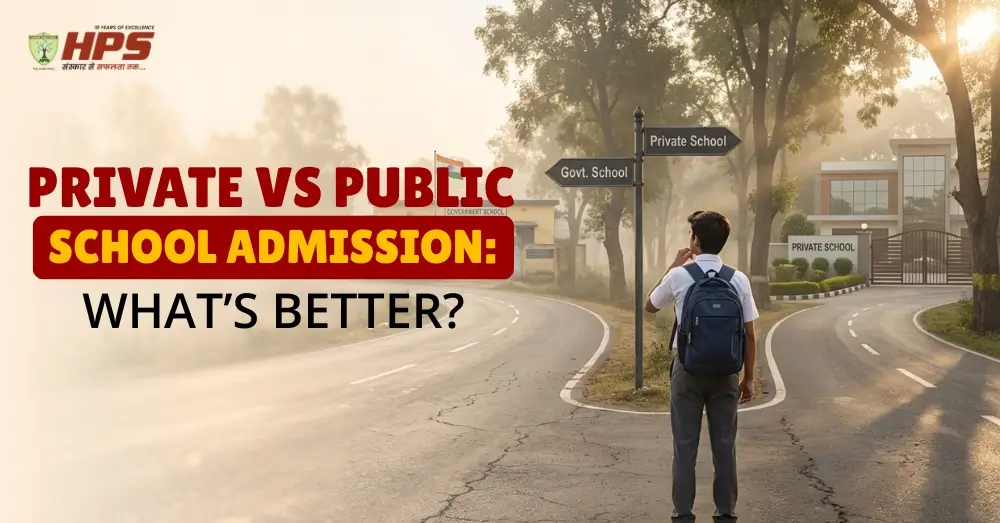
Choosing the right school for your child is not easy. The moment admission season starts, one question keeps coming back to your mind: Private vs Public School, what should be the right choice?
It’s tough to choose between the two options, as they offer distinct benefits. Public schools are known for being accessible and affordable for everyone. On the other hand, private schools often focus on smaller class sizes, modern facilities, and giving your child a little extra individual attention.
At last, what matters most is finding a place that fits your child’s unique personality and your family’s goals. If you are feeling a bit stuck making the right decision, then read this blog till the end, as it explains the major differences between private and public schools and the perfect choice for your child.
What Are Public Schools?
Public schools are government-funded and run by the state or central government. They follow a standard curriculum set by CBSE or their respective state boards. Admission is either free or available at a very nominal cost, which makes them accessible to families across all income levels.
What Are Private Schools?
Read more: Why choose a CBSE school for your child’s future?
Private schools are independently managed institutions. They can be affiliated with CBSE, ICSE, or state boards, and they generally have more flexibility in how they structure their academic programs, hire staff, and manage their facilities.
Parents pay fees to enrol their children, and in return, they expect a higher standard of teaching, infrastructure, and opportunities. Private schools have grown significantly across India, especially in towns and semi-urban areas where parents are looking for quality education closer to home.
Key Differences Between Private and Public Schools
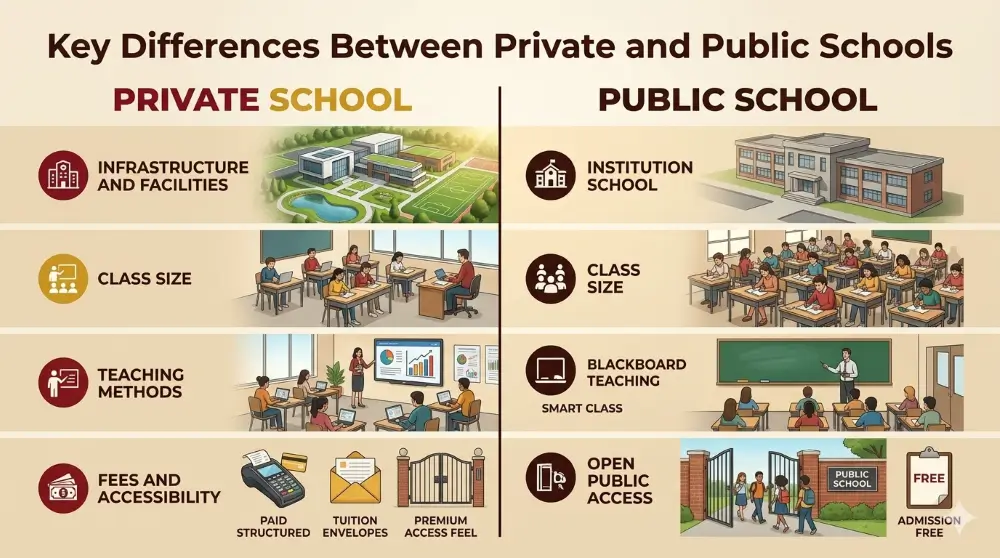
Private schools and public schools have many key differences. To decide which one is the right fit for your child, let’s understand each of them in detail:
1. Infrastructure and Facilities
One of the biggest differences between Private vs Public School is the learning environment. Public schools may have basic classrooms and limited facilities, especially in smaller towns and villages. Some schools may not have well-equipped science labs, computer rooms, or sports areas. However, Private schools usually invest more in infrastructure, such as smart classrooms, science and computer labs, libraries, sports grounds, music and dance rooms, and activity spaces for kids. A better environment can make learning more interesting and enjoyable for your child.
2. Class Size
Class size matters because it affects how much attention your child receives.
Public schools often have a larger number of students in one class. Sometimes, a single teacher may have to manage 40 to 60 students at a time, which is a common concern when comparing Private vs Public School. However, Private schools usually keep class sizes smaller. This allows teachers to understand each child better, give personal attention, encourage classroom participation, and help students who need extra support. When your child gets more attention, it becomes easier to build confidence and improve performance.
3. Teaching Methods
Public schools mostly follow traditional teaching methods, which is a key point when comparing Private vs Public School. The focus is often on textbooks, written work, and exams. Private schools usually use more interactive methods. Teachers may include group discussions, smart boards, project-based learning, activity-based lessons, and practical learning. These methods help your child understand concepts instead of only memorizing them.
4. Fees and Accessibility
When you compare private vs public school admission, cost is one of the biggest factors. Public schools are more affordable. They are a good option if you want quality education at a lower cost. Meanwhile, private schools charge higher fees because they provide extra facilities, activities, and support. However, many parents feel that the additional cost is worth it because of the overall learning experience.
Which One Is Better?
There is no single answer that works for every child when it comes to Private vs Public School. If you are looking for affordable education and easy access, a public school may be the right option. But if you want better facilities, smaller class sizes, individual attention, strong extracurricular activities, and a modern approach to learning, then a private school may be a better choice. To be honest, the best school is the one where your child feels comfortable, supported, and excited to learn.
Why HPS Is the Best Private School for Your Children?
At Haryana Public School (HPS), Narnaul, we know that you are not just looking for a school. You are looking for the right environment where your child can grow academically, socially, and as a person.
HPS is a CBSE-affiliated, best private school in Narnaul, Haryana, that offers modern infrastructure, well-equipped labs, a library, dedicated sports facilities, and smart classrooms. Our class sizes are managed carefully so that every student gets the individual attention they deserve, because no two children learn the same way.
Beyond academics, we at HPS offer a full range of co-curricular activities, including sports, music, art, and debate programs. We believe school should be a place your child genuinely enjoys coming to every day.
We also place a strong emphasis on Indian values and character development, because at HPS, we are not just building good students, we are building good human beings. And this is the reason we built a foundation for students called Sanskar se Saflta Tak, where we teach them our Indian culture & tradition, along with preparing them for the real-world challenges. Our teachers are also trained to recognize each child’s strengths and nurture them with patience and care.
Conclusion
The private vs public school admission decision does not have one universal answer. Both school types serve important roles, and both have their own advantages. Your decision should be based on your child’s learning needs, your family’s budget, the quality of teaching, and the overall environment the school provides.
What matters most is not the label private or public, but whether the school is genuinely committed to your child’s growth.
If you are looking for a private school that balances quality education, individual attention, strong values, and a warm learning environment, HPS Narnaul is here for you. To know more or apply for admission, visit HPS Narnaul or call 8199965994.
FAQs:
1. Are private schools better than public schools?
Not always. Private schools generally offer better infrastructure and more individual attention, but the quality of teaching and the school environment matter more than the type. A committed government school teacher can be just as impactful as one in a private school.
2. Are public schools more affordable than private schools?
Yes, Government schools are free or nearly free, which makes them the go-to option for families with budget constraints. Private school fees vary widely, from affordable to quite high, depending on the institution.
3. Do private schools offer better extracurricular activities?
In most cases, yes. Private schools tend to have more resources to invest in sports, arts, music, and other activities. These experiences play a big role in your child’s overall development, beyond just academics.
4. Can students succeed in both private and public schools?
Absolutely. Success depends on the child’s dedication, the support they get at home, and the quality of teaching they receive, not just the type of school. Many of India’s most successful people have come from government schools.
5. What factors should parents consider before choosing a school?
Look at the school’s curriculum, teachers’ qualifications, class size, facilities, extracurricular options, fees, location, and the values the school promotes. Visiting the campus in person and talking to current parents can give you a much clearer picture before making a final decision.