Do you remember the feeling of sitting in an exam hall, staring at a question paper, and suddenly realizing that the clock is ticking faster than your writing speed? That blank-out moment or the panic of leaving questions worth 10 marks unanswered because you ran out of time is a common nightmare for many students.
The reason is not a lack of knowledge. It is a lack of practice under real exam conditions, and this is where mock tests come in. Mock tests are not just practice papers; they are one of the most powerful tools a student can use to walk into the exam hall feeling calm, prepared, and genuinely confident.
Let’s dive deeper into this blog to know what mock tests really are, importance of Mock Tests for exam preparation and why every student should be taking them seriously.
Understanding the Concept of Mock Tests
A mock test is a practice exam designed to simulate the actual exam as closely as possible. It follows the same format, time limit, marking scheme, and difficulty level as the real paper.
The whole point of a mock test is not just to attempt questions. It is to recreate the pressure, practice, and mental effort of the actual exam so that when the real day arrives, you have already been through it before, at least in practice.
Think of it like a rehearsal before the main performance. A singer does not walk on stage without practising. An athlete does not show up on race day without training. Similarly, a student should not appear for board exams, entrance exams, or competitive tests without practising through mock tests first.
What is the Importance of Mock Tests for Exam
Preparation?
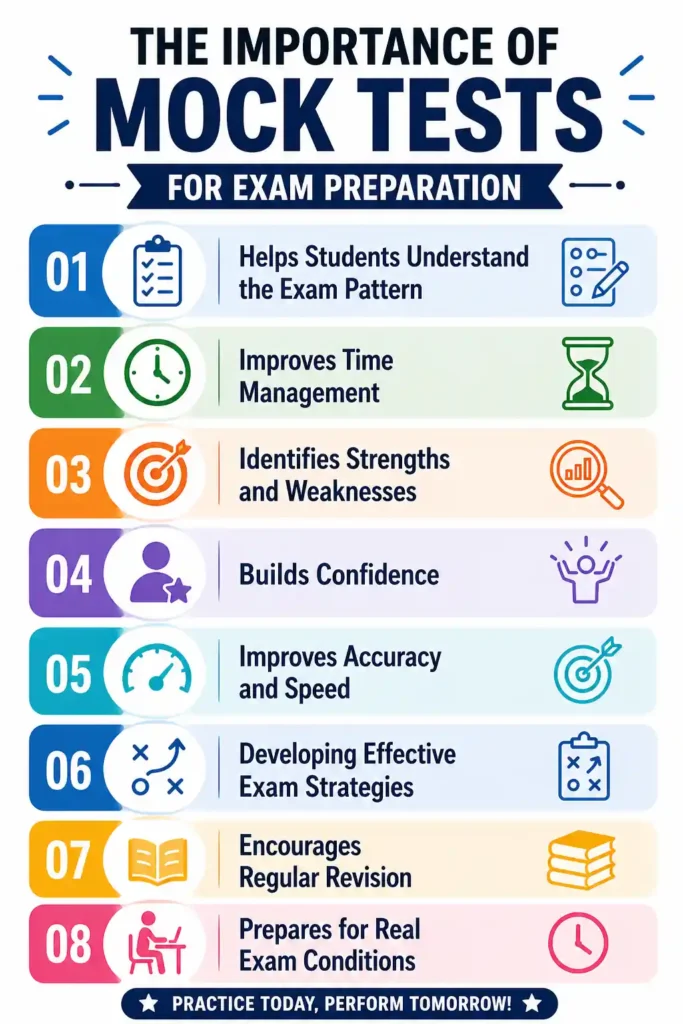
There are many reasons teachers and educators strongly recommend mock tests. Let’s understand why:
- Helps Students Understand the Exam Pattern
Every exam has its own structure. Some focus on MCQ-based logic, while others require long, descriptive answers. Mock tests familiarize you with the blueprint of the exam. You will know exactly how many sections are there and which chapters carry the most weightage.
- Improves Time Management
Time is one of the biggest challenges you face during exams. You might know the answers, but fail to finish the paper. Mock tests teach you how to divide your time, and they help in understanding that you should not spend 15 minutes on a 2-mark question. Over a few attempts, your child naturally learns how much time to spend on each section and when to move on instead of getting stuck on one question.
- Identifies Strengths and Weaknesses
Mock tests show you exactly where you stand, honestly and clearly. After every mock test, you should sit down and check where you lost marks. Was it a particular chapter? A certain type of question? Calculation errors? This analysis turns every mock test into a personal study guide. You stop wasting time on topics you already know and start focusing on the areas that need more work.
- Builds Confidence
Anxiety often comes from a fear of the unknown. When you have already given the exam five times in the form of mocks, the sixth time (the real one) feels like just another day at your study desk. Your brain stays calm, your hands don’t shake, and you can focus entirely on the questions.
- Improves Accuracy and Speed
Speed without accuracy is useless, and accuracy without speed leaves the paper incomplete. Mock tests help you find that balance. With repeated practice, you start solving problems faster because your mind has already worked through similar patterns before. This is especially important for exams like the CBSE board exams, JEE, or NEET, where both speed and accuracy matter significantly.
- Developing Effective Exam Strategies
Should you start with the long-answer section or finish the MCQs first? There is no one-size-fits-all answer. Mock tests allow you to experiment. You can try different approaches and see which one gets you the highest marks without feeling rushed.
- Encouraging Regular Revision
One of the hidden benefits of mock tests is that they naturally push you into regular revision. When you know a mock test is coming up, you go back to your notes. You revise chapters. You test your memory. This kind of consistent revision is far more effective than last-minute cramming. It moves information from short-term memory into long-term retention, which is exactly what you want on exam day.
- Preparing Students for Real Exam Conditions
Sitting still for three hours, managing anxiety, reading carefully, and maintaining focus is a skill in itself. Mock tests teach you how to handle the actual exam environment, including the pressure, the silence, the clock, and the bulk of questions. Mock tests help you to build the physical and mental stamina required to stay focused for long durations without getting distracted or exhausted.
Conclusion
At the end of the day, exam success is not just about how hard you work, but how smart you practice. The importance of mock tests for exam preparation cannot be overstated. They are the bridge between your hard work and the results you dream of. If you have not started taking them yet, now is the time to begin. Take every mock test seriously, analyze your mistakes, and keep improving.
FAQs
What is a mock test in exam preparation?
A mock test is a practice exam that follows the exact pattern, syllabus, and time limit of the actual examination to help students prepare.
Why are mock tests important for students?
They help in identifying weak areas, improving time management, and reducing the fear of the actual exam.
Do mock tests help reduce exam stress?
Yes, by familiarizing you with the exam format and environment, they build confidence and significantly lower anxiety levels.
Are mock tests useful for board exams?
Absolutely. They are essential for understanding the marking scheme and learning how to present answers within the word limit.
Should students analyze their mock test results?
Yes. Taking the test is only half the job. Analyzing where you went wrong is what actually helps you improve your score.