
Have you ever watched a group of children playing during recess? Some are leading a game, some are negotiating rules, and others are figuring out how to join in. While it looks like simple fun, what you are actually witnessing is one of the most critical parts of growth, and that is social development.
In today’s world, being smart is not just about scoring an A+ in Math or Science. It’s about how well you navigate the world around you and the people in it. According to research by the National Library of Medicine, positive social interactions during childhood are foundational to mental health and long-term success.
So, let’s talk about what social development in students actually means, why it matters more than most people realise, and how you can support it for your kids both at home and in school.
What is Social Development in Students?
Social development in students refers to the process by which kids learn how to interact with others, build relationships, manage emotions, and become contributing members of a group, whether that’s a classroom, a family, or eventually, a workplace.
It’s not just about being friendly or having good manners, though those matter too. But it includes understanding how to listen, how to disagree respectfully, how to lead when needed, and how to step back when someone else needs space to shine.
Why Social Development is Important for Students
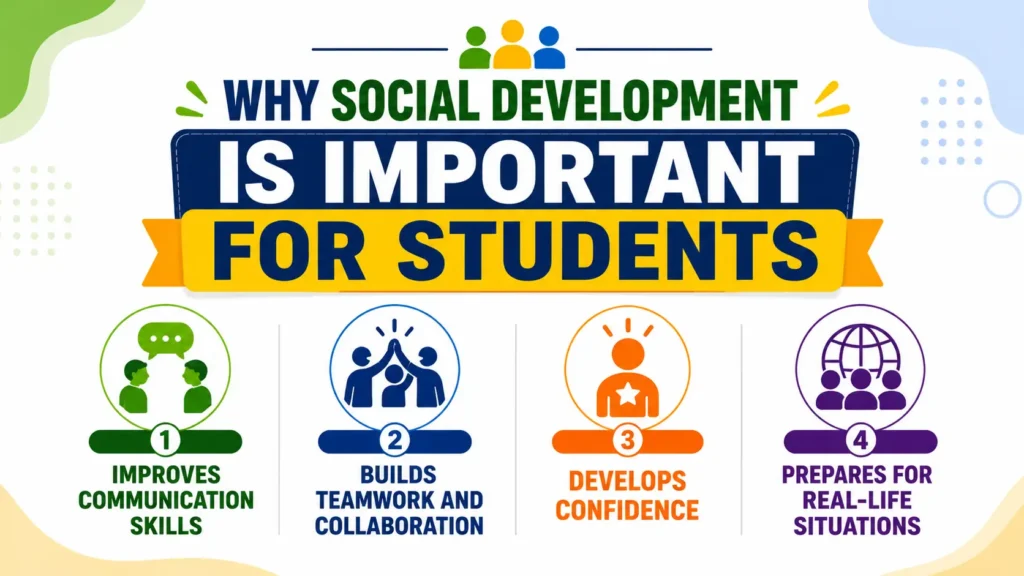
Academic excellence can only take a person so far, but social growth is very important. Why? Let’s understand this in detail:
- Improves Communication Skills
Social development teaches your kids how they can express their thoughts clearly and, more importantly, how to listen. Good communication prevents misunderstandings and helps them build deeper connections with people around.
- Builds Teamwork and Collaboration
Whether it’s a science project or a football match, almost everything in life requires working with others. Students who develop strong social skills learn how to contribute their strengths to a group while respecting the input of others.
- Develops Confidence
When your child knows how to introduce themselves, ask for help, or stand up for what is right, their self-esteem naturally grows. A socially confident student is not afraid to take risks or speak up in class.
- Prepares for Real-Life Situations
The real world does not have a syllabus. It has colleagues, neighbours, and strangers. By focusing on social growth now, students are essentially practising for the workplace and adulthood, where people skills are often the deciding factor in career growth.
How Students Learn Social Skills in School
Schools provide an environment for social learning when children use it well. Let’s understand in detail how students learn social skills in school:
- Group Activities: Projects and lab work teach students to delegate tasks and trust one another.
- Extracurriculars: Sports, drama, and debate clubs teach students how to handle both victory and defeat gracefully.
- Structured Play: Even during lunch breaks, students are learning the art of negotiation and the importance of taking turns.
Key Social Skills Every Student Should Develop
If you want to support your child’s journey, keep an eye out for these five essential skills:
- Empathy: The ability to understand and share the feelings of another.
- Active Listening: Paying full attention to the speaker rather than just waiting for your turn to talk.
- Conflict Resolution: Finding a peaceful solution to a disagreement.
- Patience: Learning that not everything happens the moment you want it to.
- Respect: Valuing the boundaries and opinions of others, even when they differ from your own.
Common Social Challenges Faced by Students
Not every child finds social situations easy, and that’s completely normal. Some kids are naturally shy and find group settings overwhelming. Others might dominate conversations without realizing it. Some struggle to make friends because they don’t know how to initiate a conversation, while others find it hard to handle rejection or exclusion.
Peer pressure is another very real challenge because wanting to fit in is a natural human need, and kids often make poor decisions just to feel accepted. Without guidance, this can lead to a lot of unnecessary pain. The goal is not to eliminate these challenges; it’s to help children develop the strategies to navigate them.
Role of HPS in Social Development
At HPS, Narnaul, we believe that social development in students is not something that happens on its own. It needs to be intentionally woven into everyday school life.
Our group activities, collaborative projects, house competitions, and school events are all designed with this in mind. When kids work in teams for a science fair or perform on the stage for a cultural programme, they are not just completing a task; they are learning to coordinate, communicate, and build trust with each other.
Our teachers are trained to observe social dynamics in classrooms. If a child is withdrawing from group interactions or struggling to connect with peers, we don’t ignore it. We address it gently, thoughtfully, and with the child’s comfort in mind.
We also make sure that the school environment itself is safe and inclusive. Every child at HPS is encouraged to participate, speak, and grow, no matter how reserved or outgoing they are by nature.
How Parents Can Support Social Development
School can do a lot, but you are your child’s first and most important teacher when it comes to social skills. And this is how you can do it:
- Arrange playdates and group activities: Give your child regular opportunities to interact with kids of their own age outside of school.
- Talk about feelings openly: When your child comes home upset or confused after a social situation, don’t dismiss it. Sit with them, ask questions, and help them process what happened.
- Model good communication: Kids pick up far more from watching you than from anything you tell them directly, like how you handle disagreements, how you speak to others, and how you listen. All of it becomes their template.
- Avoid overprotecting: It’s natural to want to step in when your child faces conflict, but letting them work through manageable problems builds resilience.
- Praise the effort, not just outcomes: When your child tries to include a lonely classmate or handles a disagreement maturely, acknowledge and appreciate it.
Final Thought: Social Skills Shape Lifelong Success
Grades open doors. Social skills determine what your child does once they walk through those doors. The world rewards people who can communicate, collaborate, and connect. Emotional intelligence, the ability to understand and manage relationships, has been consistently linked to success in careers, mental health, and personal life. It starts in the classroom, on the playground, and at the dinner table. Social development in students is not a secondary concern; it is as central to education as any subject on the timetable. At HPS, the best school in Narnaul, we make it our priority to raise not just academically sound students, but socially confident, emotionally aware individuals who are truly ready for the world. If you want your child to grow up knowing not just how to study, but how to live, then social development needs to be part of the conversation from day one.
FAQ:Social Development in Students
What is social development in students?
Social development in students refers to the process of learning how to interact with others, form relationships, manage emotions, and work collaboratively. It includes communication, empathy, cooperation, and conflict resolution.
Why are social skills important for children?
Social skills help children build friendships, work in teams, handle conflicts, and express themselves clearly. These abilities are essential not just in school but throughout adult life in careers, relationships, and communities.
How do schools help in developing social skills?
Schools create opportunities through group projects, classroom discussions, team activities, competitions, and social events. Good schools also have teachers who observe and guide social dynamics to ensure every child feels included and supported.
What are the key social skills every student should learn?
Active listening, empathy, cooperation, conflict resolution, expressing emotions appropriately, and respecting others’ boundaries are some of the most important social skills for students.
How can shy students improve their social skills?
Shy students benefit from small group activities where the pressure is lower, consistent encouragement from teachers and parents, and gradual exposure to group settings. Forcing a shy child into social situations too quickly rarely works; patience and gentle support do.
What role do parents play in social development?
Parents model social behaviour at home, create opportunities for peer interaction, and help children process and understand social experiences. Their involvement is just as important as what happens in school.
How does teamwork help in student growth?
Teamwork teaches students to listen to others, manage disagreements, trust their peers, and work toward a shared goal. These experiences build communication, leadership, and cooperation skills that are invaluable throughout life.
Why is social development important along with academics?
Academics build knowledge, but social development builds the ability to use that knowledge in real-world settings. A student who is academically strong but socially underdeveloped will struggle in collaborative workplaces and personal relationships. Both need equal attention.