
Have you ever wondered why some students seem to manage challenges in studies while others struggle even after hours of learning? The difference often is not about how much time they put in. It’s about how solid their foundation is.
Academic development in students is not just about scoring good marks on a report card. It’s a part of student development in school, about building the kind of understanding, discipline, and thinking skills that stay with them for life. When these foundations are laid correctly from an early age, everything else, like solving a tough math problem, writing an essay, or understanding a science concept, becomes much easier.
So, if you are a parent, student, or educator who wants to understand what real academic growth looks like, this blog is for you.
What is Academic Development in Students?
When you hear the word academics, you might immediately think of heavy backpacks and long exams. But academic development is much broader than that. It is the ongoing process of gaining knowledge, honing mental skills, and developing the right attitude toward learning.
It’s not just about memorizing the periodic table or knowing which year a battle was fought. It’s about learning how to learn. It involves developing curiosity, improving communication, and building the discipline to tackle difficult problems. At its core, it is about transforming a child from a passive listener into an active thinker.
Why Strong Academic Foundations Matter?
Think of your child’s education like a building. If the base isn’t solid, no matter how beautiful the upper floors look, the structure is at risk. The same logic applies to learning.
When children don’t develop strong academic foundations early on, they tend to struggle more with complex topics as they move into higher classes. A student who does not fully understand fractions in Class 4 will find algebra tough in Class 8. A child who never develops the habit of reading will find comprehension difficult in every subject. So, it is important to make an academic foundation strong.
Concept-Based Learning vs Rote Learning
This is something every parent and student needs to understand clearly. There are two very different ways children are taught in schools, and they produce very different results.
- Rote Learning: This is like downloading a file to a computer. If the file gets corrupted (or the student forgets one word), the whole thing is lost. It doesn’t help in real-life situations.
- Concept-Based Learning: This is like teaching a child how to code. They understand the “why” and the “how.” If they understand the concept of gravity, they don’t need to memorize a paragraph about it; they can explain it in their own words.
India’s education system is moving strongly towards concept-based learning, and for good reason. Students who understand concepts retain information longer, apply it in real situations, and feel far more confident during exams.
Key Skills Developed Through Academic Learning
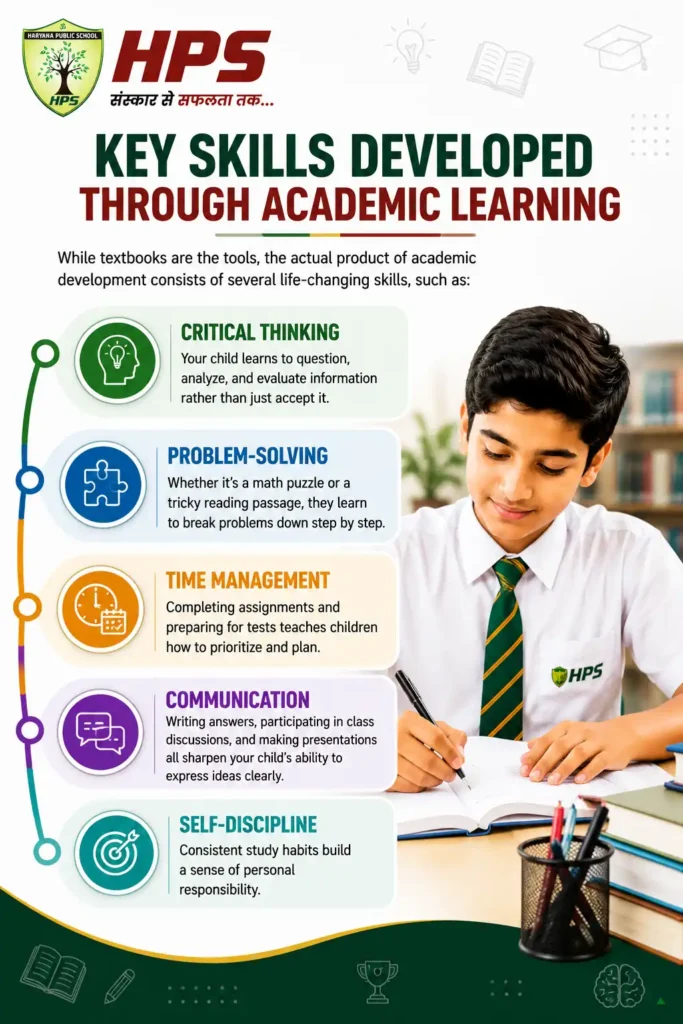
While textbooks are the tools, the actual product of academic development consists of several life-changing skills, such as:
- Critical thinking: Your child learns to question, analyze, and evaluate information rather than just accept it.
- Problem-solving: Whether it’s a math puzzle or a tricky reading passage, they learn to break problems down step by step.
- Time management: Completing assignments and preparing for tests teaches children how to prioritize and plan.
- Communication: Writing answers, participating in class discussions, and making presentations all sharpen your child’s ability to express ideas clearly.
- Self-discipline: Consistent study habits build a sense of personal responsibility.
These skills don’t show up on a mark sheet, but they make a huge difference in your child’s growth as a student and as a person.
Role of Regular Practice and Assessments
Many people ask, Why do teachers give so many tests and assignments? It’s not just to check what your child has memorized. It’s to help them actually learn.
Students who regularly revise and take tests retain information far better than those who only study before exams. This is sometimes called the testing effect, and it’s one of the most well-supported ideas in learning science.
Regular practice helps move information from short-term memory to long-term muscle memory. Meanwhile, assessments allow teachers to see where a child might be struggling so they can pivot their teaching style. It’s like a GPS; it tells us if we are on the right track or if we need to take a different route to reach the destination.
How Teachers Support Academic Growth
A teacher gives far more effort than just delivering lessons. A good teacher observes how each student learns, notices who is falling behind, adjusts their explanation when something isn’t clicking, and finds creative ways to make even dry topics feel interesting.
Teachers support academic development in students in several ways, such as:
- Breaking down complex topics into smaller, manageable parts so no child feels overwhelmed.
- Giving personalized feedback that helps students understand specifically where they went wrong and how to improve.
- Encouraging questions so students feel safe enough to say, I didn’t understand the topic, kindly repeat.
- Setting realistic goals that give students a sense of direction and achievement.
- Creating a positive classroom environment where learning feels less like a chore and more like an adventure.
At HPS Narnaul, teachers don’t just follow the textbook. They focus on making sure every student genuinely understands what is being taught, and they stay invested in each child’s progress throughout the year.
Final Thought: Strong Academics Lead to Strong Futures
Academic development in students is about far more than marks and grades. It’s about building a person who knows how to think, how to learn, and how to keep going even when things get hard.
When your child develops a strong and balanced educational foundation, they don’t just perform better in school. They grow up with the tools to handle challenges confidently, make smart decisions, and keep learning throughout their life.
At HPS Narnaul, we believe that every child is capable of building that kind of foundation. Our teachers, systems, and approach are all designed with one goal in mind: to help your child not just pass exams, but truly grow as a learner and as a person.
FAQs: Academic Development in Students
1. What is Academic Development in Students?
Academic development is the gradual process of building knowledge, learning skills, and study habits that help a student understand subjects deeply and perform well in school.
2. Why is academic development important for children?
Strong academic foundations help children handle increasingly complex topics with confidence, develop critical thinking, and build life-ready skills like time management and problem-solving.
3. What is the difference between rote learning and concept-based learning?
Rote learning involves memorizing information, while concept-based learning focuses on understanding the reasoning behind topics, which leads to better long-term retention and application.
4. How can students improve their academic performance?
By studying regularly, practicing past papers, asking questions when in doubt, and focusing on understanding concepts rather than just cramming for exams.
5. What role do teachers play in academic development?
Teachers break down complex topics, give personalized feedback, encourage curiosity, and create a positive learning environment that helps each student grow at their own pace.
6. How do assessments help in academic development?
Regular tests and assignments help identify learning gaps early, reinforce memory, build exam confidence, and train students to recall information under pressure.
7. At what age should academic development start?
It begins from the very first day of schooling. Early years focus on foundational skills like reading, writing, and numerical understanding, which become the base for all future learning.
8. How can parents support their child’s academic development?
By creating a consistent study environment at home, showing interest in what their child is learning, encouraging reading, and staying in regular communication with teachers.