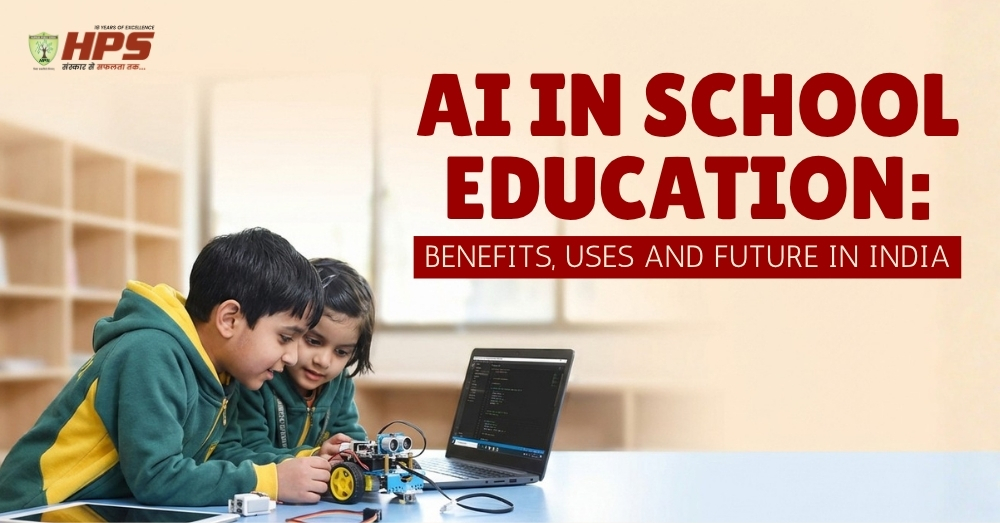
Your child already uses AI in daily life, even if you do not notice it. From voice assistants to learning apps that suggest the next lesson, artificial intelligence is becoming part of how kids learn.
That is why many parents and schools are now paying attention to AI in school education. The idea is not to replace teachers. It is to make learning more personal, faster, and easier for every student.
According to the Press Information Bureau, Government of India, the National Education Policy (NEP) 2020 has formally recommended introducing Artificial Intelligence at relevant stages of the school curriculum, and CBSE has already introduced AI as a subject in Class IX and Class XI.
Now, let’s deep dive into this blog to understand more about the uses and benefits of AI in school education.
What Is AI?
In simple terms, Artificial Intelligence (AI) is technology that allows computers and machines to simulate human intelligence. It helps devices learn from data, recognize patterns, and make decisions. When you see a Netflix recommendation or use a voice assistant like Alexa, you are interacting with AI. In a school setting, AI acts like a smart assistant that helps tailor lessons to a student’s specific needs.
Use of AI in School Education
The use of AI in school education is growing in many simple and practical ways, such as:
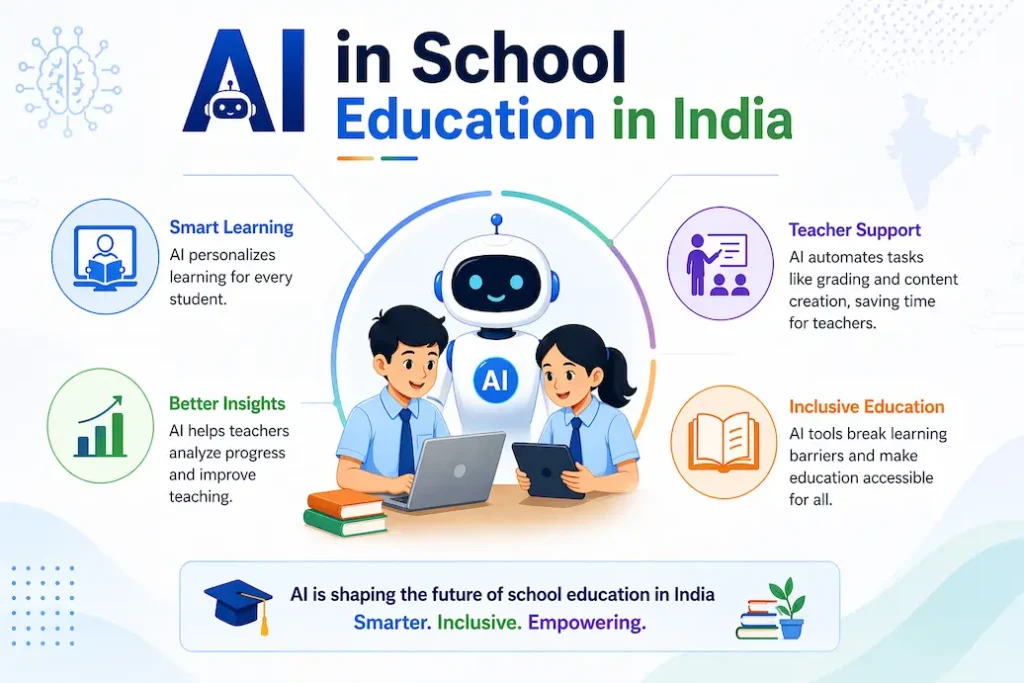
- Personalized Learning: Every child learns differently. Some understand quickly, while others need more time. AI-based learning platforms study how your child learns and then create lessons according to their speed and level. If your child struggles in science, the app may suggest extra videos, quizzes, or practice questions.
- Smart Assessments: AI can evaluate answers, identify common mistakes, and give instant feedback. This saves teachers time and gives students a quicker understanding of where they went wrong.
- Chatbots and Virtual Tutors: Many schools now use AI chatbots and virtual tutors. These tools answer student questions at any time. If your child is studying at night and gets stuck on a chapter, an AI tutor can explain the topic instantly.
- Better School Management: AI is not only for students. Schools also use it to manage attendance, timetables, fee reminders, parent communication, and to make student progress reports. This makes school work smoother and more organized.
AI in School Education in India
In India, the journey has already begun. From urban private schools to government-led initiatives in rural areas, AI in school education in India is bridging the gap. The CBSE board has already introduced AI as a subject in secondary schools to prepare students for a tech-driven world.
Moreover, platforms like DIKSHA are using technology to provide high-quality resources to teachers and students nationwide. This ensures that a student in a small village has access to the same quality of logic and learning materials as a student in a metro city.
Benefits of AI in School Education
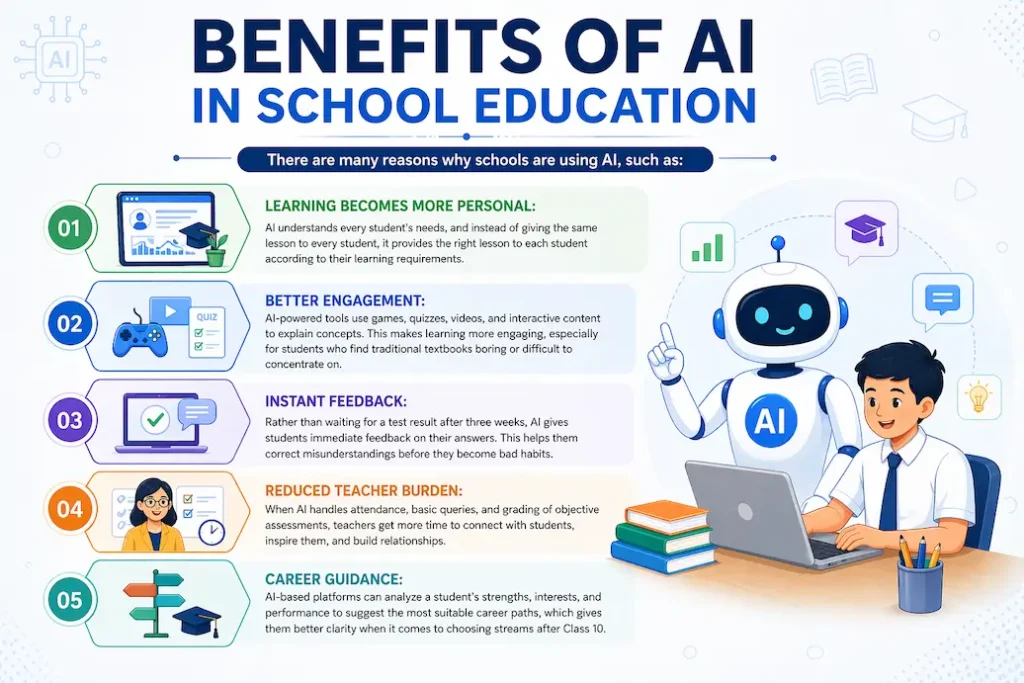
There are many reasons why schools are using AI, such as:
- Learning becomes more personal: AI understands every student’s needs, and instead of giving the same lesson to every student, it provides the right lesson to each student according to their learning requirements.
- Better Engagement: AI-powered tools use games, quizzes, videos, and interactive content to explain concepts. This makes learning more engaging, especially for students who find traditional textbooks boring or difficult to concentrate on.
- Instant Feedback: Rather than waiting for a test result after three weeks, AI gives students immediate feedback on their answers. This helps them correct misunderstandings before they become bad habits.
- Reduced Teacher Burden: When AI handles attendance, basic queries, and grading of objective assessments, teachers get more time to connect with students, inspire them, and build relationships.
- Career Guidance: AI-based platforms can analyze a student’s strengths, interests, and performance to suggest the most suitable career paths, which gives them better clarity when it comes to choosing streams after Class 10.
Challenges of AI in School Education
It wouldn’t be fair to only talk about the bright side of AI. Like anything new, AI in school education comes with real challenges that cannot be ignored, such as:
- Digital Divide: Not every school in India has computers, stable internet, or even electricity for the full day. Rural and low-income schools often don’t have access to the infrastructure that AI tools require. This creates a gap between students in cities and those in smaller towns or villages.
- Teacher Training: AI is only as useful as the teachers who use it. If teachers are not trained well enough to integrate these tools into their lessons, the technology stays unused or, worse, misused.
- Screen Time and Health: More AI use often means more screen time. For young children in particular, this needs to be managed carefully to avoid health and attention-related issues.
- Over-Dependence on Technology: If students rely too heavily on AI tutors and autocorrect, they may not develop the habit of thinking for themselves. Critical thinking and problem-solving are skills that need practice, not shortcuts.
Read Also: Top Scholarship Exams After 12th for Higher Education
Future of AI in School Education in India
The future of AI in Indian schools looks promising. In the coming years, you may see more AI subjects in schools, smart classrooms in smaller towns, personalized learning for every student, faster & fairer assessments, and better support for students.
India is already moving in this direction. As schools continue to use technology wisely, AI in school education in India can help children become more confident, creative, and ready for tomorrow.
Conclusion
The future of learning is changing, and AI in school education is becoming an important part of that change. At HPS, Narnaul, we believe that an AI tool and a qualified teacher both play important roles in shaping your child’s growth. We encourage our teachers to use AI while explaining topics so that your child understands the concept better.
As AI evolved in India, we at HPS Narnaul became committed to preparing our students not just to use technology but to think critically, learn deeply, and grow into confident individuals who are ready for whatever the future holds. Because education is not just about information, it is about shaping who your child becomes.
FAQ
Why is AI important in school education?
AI makes learning more personalized, efficient, and accessible. It helps teachers focus on students rather than administrative tasks and gives every child a chance to learn at their own pace.
How does AI help students learn better?
AI tools adapt to each student’s learning speed and style, provide instant feedback, and use interactive content like quizzes and videos that make difficult concepts easier to understand.
What are examples of AI tools used in schools?
Some examples include DIKSHA (Ministry of Education’s platform), SWAYAM, AI-based chatbots for doubt-solving, adaptive learning apps, and smart assessment platforms.
Can AI improve student performance in schools?
Yes. When used correctly, AI can identify learning gaps early, offer targeted practice, and give students consistent feedback, all of which contribute to better performance over time.
How does AI support teachers in the classroom?
AI handles time-consuming tasks like attendance tracking, basic assessments, and data management, giving teachers more time and energy to connect personally with their students.
Is AI education important for future careers?
Absolutely. With India’s AI market growing rapidly, students who understand how to work with AI will have a significant advantage across careers in technology, healthcare, business, and beyond.