Preschool age is something every parent starts thinking about as they closely observe their child’s journey from an infant to a slightly growing toddler. The kid who used to play with small toys now starts playing with some educational and developmental toys like block building, color recognition, etc.
It’s a bittersweet moment when you realize they are not babies anymore, and you start thinking about their early learning and preschool.
Now the biggest question comes to mind: Is it the right time to enroll them in preschool?
According to the National Education Policy (NEP) 2020, over 85% of a child’s cumulative brain development occurs before the age of 6. The policy emphasizes that Early Childhood Care and Education (ECCE) from age 3 onwards plays a vital role in shaping a child’s cognitive, social, and emotional growth.
But every child is different; some speak early, some walk early, and some learn early, so it can be confusing to decide on the right preschool age. So, let’s understand in detail what the right preschool age is and how you will decide the right preschool age for your kid.
What Is Preschool?
Preschool is an early childhood education program designed for your kids before they enter kindergarten or Grade 1. It’s a place where your child learns through small games, exploration, and structured activities in a nurturing environment.
This is not like traditional schools that focus on textbooks; a preschool focuses on teaching how to learn. It’s a place where your child develops social skills, emotional regulation, and basic motor skills through playing, painting, and interaction.
Preschool Age Meaning
“Preschool age” refers to the developmental stage when your child is ready to participate in various activities outside the home. This typically comes between 2.5 to 6 years, depending on individual development and school-specific requirements. It is about your child’s physical, emotional, and social readiness to engage with peers, follow basic routines, and explore a new learning environment.
Preschool Age Group
To make it easier for you to plan the right preschool-age group for your child, here is a detailed table for better understanding:
| Class | Age Group | Focus Areas |
| Playgroup / Pre-Nursery | 2 to 3 Years | Sensory play & Socialization |
| Nursery | 3 to 4 Years | Language skills & Basic Etiquette |
| Junior KG (LKG) | 4 to 5 Years | Pre-writing & Number recognition |
| Senior KG (UKG) | 5 to 6 Years | Reading readiness & Phonics |
Ideal Age for Preschool Admission
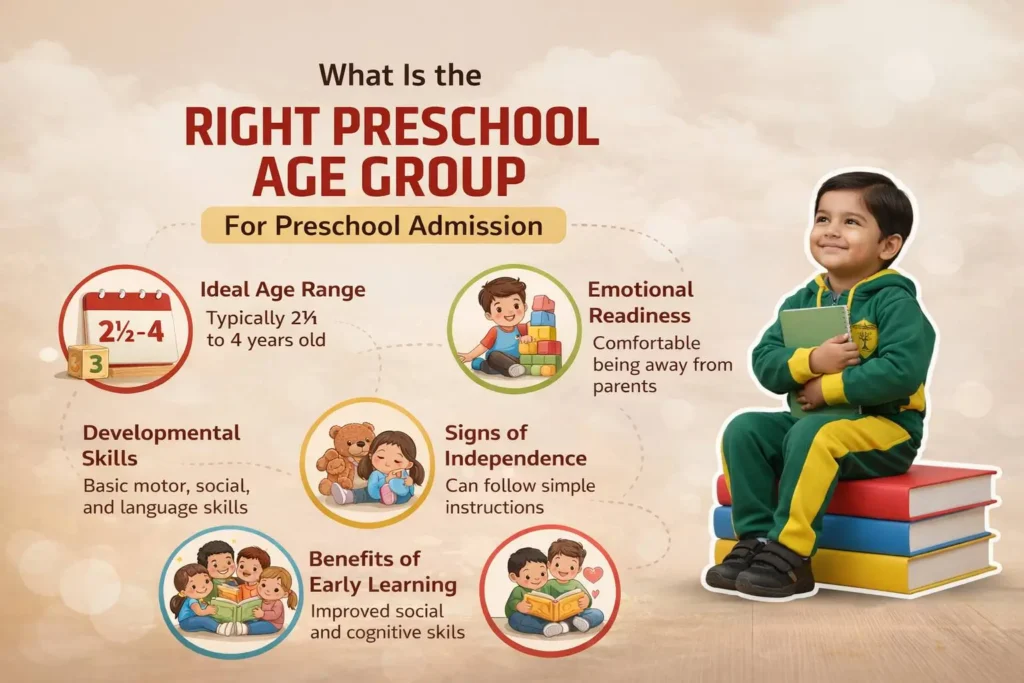
Most children are ready for preschool between the ages of 2.5 to 4 years. The NEP 2020 emphasizes that early childhood care and education should begin at age 3 for optimal development.
However, the ideal age for preschool admission depends on your child’s individual growth and readiness. Some kids show signs of readiness earlier, while others might benefit from starting a little later.
Age is just one factor; your child’s mental & physical development matters much more.
Why Preschool Age Is Important for Child Development
Many parents question, why can’t we just teach them drawing & coloring at home? While you certainly can, the preschool program offers a unique social ecosystem. In a preschool setting, your kids learn empathy, sharing, taking turns, expressing themselves, and handling new situations with confidence. Moreover, preschool at the appropriate age introduces your child to structured learning in a playful, non-pressured environment.
This period is critical because it’s when your child’s brain is ready to adapt to new activities easily. This makes the transition to formal schooling much smoother when they reach Grade 1.
Is Age the Only Factor for Preschool Admission?
No, age alone doesn’t decide your child’s preschool readiness. There are many other factors that you should consider, such as your child’s ability to stay away from you for short periods, basic communication skills, interest in other children, and physical readiness. Some kids are emotionally and socially ready at 2.5 years, while others need more time, even at 3.5 years.
Signs Your Child Is Ready for Preschool
How do you know if your child is ready for preschool? Look for these signs:
- Independence: If your child can eat, drink, or speak without anyone else’s help, then it’s a positive sign that they are ready for preschool.
- Communication: Can they express their basic needs, like “I am thirsty” or “I need to go to the toilet”? Then they are ready for preschool.
- Curiosity: Do they seem bored at home or eager to meet other kids? Then this curiosity about peers is a strong readiness sign.
- Separation: If your child can comfortably spend time with relatives or peers outside without constant anxiety, they are likely ready for preschool.
- Manage Reactions: They might still have tantrums, but if they recover quickly and their reactions become less intense, then they are ready to join preschool.
What If a Child Is Younger or Older Than the Age Group?
If your child is younger than the typical preschool age group but shows all readiness signs, you can consider early admission. However, make sure they can handle the physical and emotional demands of a classroom setting.
If your child is older than the standard age group, there’s absolutely nothing to worry about. Every child develops differently, and some simply need more time to build confidence and independence. Starting later doesn’t mean your child is falling behind; it means starting when they are actually ready.
Benefits of Starting Preschool at the Right Age
When your child starts preschool at the right age, they develop many things in their personality, such as:
- Confidence: Your child gains a sense of confidence in everything they do, like, “I can do it myself.”
- Routine: They follow an everyday routine that involves prayer time, snack time, game time, or rest time.
- Foundation: It builds the pre-academic skills (like holding a pencil or recognizing shapes) that make Class 1 much less intimidating.
Common Myths About Preschool Age
- Myth 1: Earlier is always better
Not true. Starting too early when your child is not ready can create anxiety and negative feelings about school.
- Myth 2: If my child doesn’t start at the age of 2.5, they will fall behind
Not true, every child develops differently. Starting at 3 or even 3.5 years is perfectly fine if that’s when your child is ready.
- Myth 3: Preschool is just expensive babysitting
No, preschool is about structured learning, social development, and preparing kids for formal education through play-based learning.
- Myth 4: Only kids who know ABCs and 123s are ready
Preschool readiness is about social and emotional development, not academic knowledge. That’s what preschool teaches.
Conclusion
Choosing the right preschool age is about balancing your child’s biological age with their emotional readiness.
Remember, the preschool age has no strict connection to your child’s birth year. It is more about their ability to get involved in a classroom environment, engage with peers, and explore new activities with confidence and curiosity.
At HPS Narnaul, we promote this preschool framework for kids, and we are committed to supporting kids at every stage of their preschool journey. No matter when your children start their preschool journey, we ensure the nurturing care and quality education they need to flourish.
To learn more about our preschool programs or to schedule a campus visit, contact us at 8199965994 or visit HPS Narnaul.
FAQs:
1. At what age does preschool start?
Typically, preschool starts between 2.5 to 3 years of age. However, the exact starting age depends on your child’s individual development and the school’s admission criteria.
2. What age is preschool and kindergarten in India?
Preschool usually covers ages 3 to 4 (Nursery), while Kindergarten includes LKG (4-5 years) and UKG (5-6 years).
3. Is my child too young for preschool?
If your child cannot stay away from you even for short periods, shows no interest in other children, or cannot communicate basic needs, they might need more time before starting preschool.
4. Should I force my child to join preschool early?
Never force early admission. Starting preschool before your child is ready can create anxiety and negative feelings about school that may last for years.
5. My child doesn’t talk much; can they still join preschool?
Yes, as long as your child can express basic needs through gestures or simple words. Preschool actually helps improve language and communication skills.
6. Will preschool put pressure on my child?
A good preschool uses play-based learning, meaning there is zero pressure. It’s all about fun and exploration.
7. My child is active and doesn’t sit in one place. Is preschool suitable?
Absolutely. Preschools are designed for active kids. They incorporate movement and “active learning” into the curriculum.
8. Will my child fall behind if we delay preschool?
Not necessarily, but they might miss out on the socialization benefits. If you delay, try to ensure they interact with peers in parks or other social gatherings.
9. Is preschool necessary before kindergarten?
While not mandatory, it is highly recommended to help the child adjust to the structure of kindergarten without feeling overwhelmed.