
Think back to your own school days. What do you remember more? Is it the complex algebraic formulas you memorized for a Tuesday morning test, or is it the way you felt when you made your first real friend, failed at a sport, or finally overcame the fear of speaking in front of the class? Obviously, you know the answer well.
For a long time, the world viewed schools as fact factories with only a goal to pour information into a student’s head and measure success by a percentage on a report card. But today, we know better. Education is not just about the grades your child brings home; it’s about the person they are becoming. This is why emotional development in students is as important as academic development.
Research from the National Library of Medicine highlights that when students have a positive emotional state, they are much more likely to stay focused, participate in class, and commit to learning. Essentially, a happy and emotionally stable mind is a mind that is ready to excel.
What is Emotional Development in Students?
Emotional development is the process of learning how to understand, express, and manage feelings. It’s not just about being happy. It’s about a student recognizing when they are frustrated and knowing how to calm down. It’s about feeling empathy for a classmate who is sitting alone. It is a crucial part of overall student development.
It involves building Emotional Intelligence (EQ), which includes self-awareness, self-regulation, motivation, and social skills. When a child understands their emotions, they are not controlled by them. Instead, they use those emotions to navigate the world around them more effectively.
Why Emotional Development is as Important as Academics
Many academically brilliant students struggle in real life because they were never taught how to handle pressure, failure, or relationships.
When your child has strong emotional development, they don’t just survive difficult moments; they grow from them. They handle exam pressure without breaking down. They collaborate with teammates instead of fighting. They speak up for themselves without being aggressive.
It has been observed that students with higher emotional intelligence also perform better academically. Why? Because a calm, focused, and self-aware child can concentrate better, retain information longer, and stay motivated even when things get tough.
Emotional development also protects your child’s mental health. With anxiety, stress, and burnout becoming increasingly common among school students in India, building emotional resilience early on is no longer optional. It’s essential.
Common Emotional Challenges Students Face
Growing up today is quite different from how it used to be. Now, students face a lot of pressure that can weigh heavily on their emotional health, such as:
- Peer Pressure: The need to fit in can lead to significant stress and a loss of self-identity.
- Academic Anxiety: The fear of failure or the pressure to perform can lead to test phobia and chronic stress.
- Social Media Impact: Constant comparison with others online can hurt a student’s self-esteem.
- Bullying and Conflict: Navigating social hierarchies and resolving disagreements requires a high level of emotional maturity that many students are still developing.
Then there’s loneliness and social withdrawal, especially after the pandemic years. Many students still struggle to rebuild social connections and feel genuinely included.
When these challenges go unaddressed, they don’t disappear. They show up later as poor self-esteem, strained relationships, or persistent mental health struggles. This is exactly why emotional development needs to be taken seriously, at home and at school.
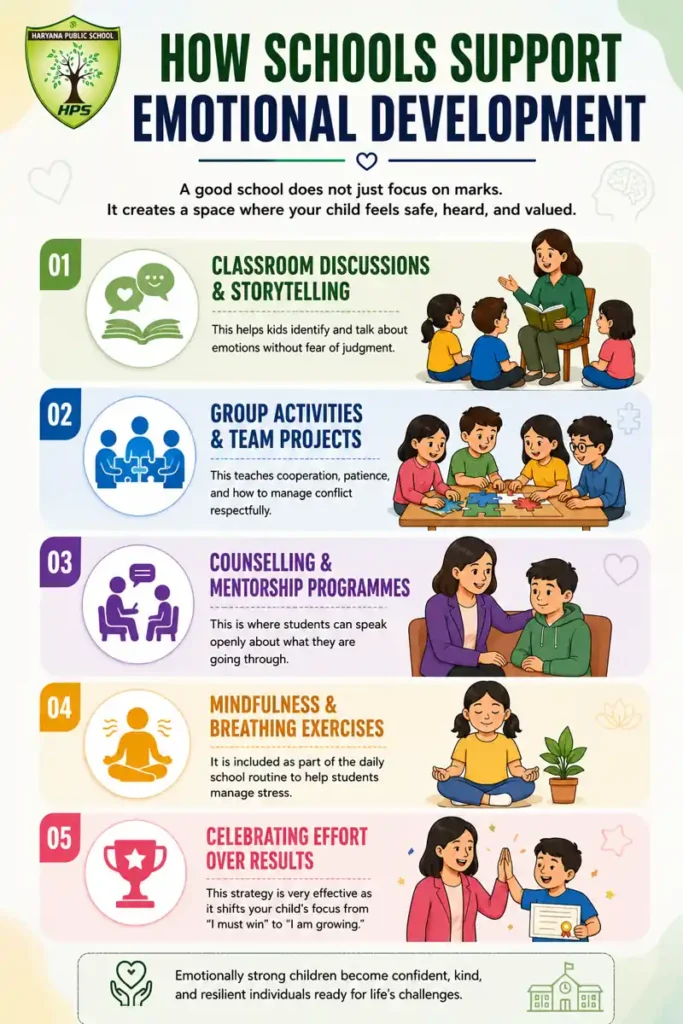
How Schools Support Emotional Development
A good school does not just focus on marks. It creates a space where your child feels safe, heard, and valued. There are several meaningful ways schools can support emotional development, such as:
- Classroom discussions and storytelling: This helps kids identify and talk about emotions without fear of judgment.
- Group activities and team projects: This teaches cooperation, patience, and how to manage conflict respectfully.
- Counselling and mentorship programmes: This is where students can speak openly about what they are going through.
- Mindfulness and breathing exercises: It is included as part of the daily school routine to help students manage stress.
- Celebrating effort over results: This strategy is very effective as it shifts your child’s focus from I must win to I am growing.
When teachers are trained to notice emotional cues and respond with empathy, it makes a huge difference. A child who feels understood by their teacher is far more likely to feel confident in class and engaged in learning.
Role of Parents in Emotional Development
There are some simple but powerful ways you can support your child’s emotional growth:
- Validating Feelings: Instead of saying don’t be sad, try saying I can see you are upset, do you want to talk about it? This helps them to understand that their emotions valued.
- Modeling Behavior: Your child watch how you handle stress. If you stay calm when things go wrong, they learn that they can too.
- Encouraging Unproductive Time: Not every hour has to be about studying. Give them time to play, reflect, and just be. This reduces the emotional fatigue of a busy school day.
- Listening Without Judging: Sometimes, your child does not need a solution; they just need to be heard.
Final Thought: Success Needs Both Mind and Emotions
It is true that you don’t just want your kids to clear competitive exams, but you want them to build friendships that last, handle setbacks without falling apart, and grow into a human being who treats others with kindness and themselves with respect.
That kind of success is only possible when emotional development in students walks hand in hand with academics.
At HPS, the best school in Narnaul, we understand that a child’s growth is never one-dimensional. So, we provide an environment where our teachers are trained to recognize not just academic gaps, but emotional ones too. Through mindful classroom environments, counselling support, collaborative activities, and a culture of empathy, we make sure your child becomes an all-rounder. For more information, you can visit our website https://hpsnarnaul.co.in/ and contact us at 8199965994
FAQ
What is emotional development in students?
Emotional development in students refers to the process of learning to understand, express, and manage one’s emotions. It also includes building empathy, handling stress, and forming healthy relationships with others.
Why is emotional development important for students?
It helps students handle pressure, build resilience, maintain mental health, and develop skills that directly support better academic performance and stronger social connections.
How does emotional intelligence affect academic performance?
Students with strong emotional intelligence can focus better, manage exam stress, stay motivated, and work well in teams, all of which contribute to improved academic outcomes.
What are common emotional problems faced by students?
Exam anxiety, fear of failure, peer pressure, bullying, loneliness, and low self-esteem are among the most common emotional challenges students face today.
How can schools support emotional development?
Schools can support it through counselling programmes, empathy-driven teaching, group activities, mindfulness practices, open classroom discussions, and celebrating effort over results.
What role do parents play in a child’s emotional growth?
Parents play a foundational role by actively listening, naming emotions, modelling healthy behaviour, and creating a home environment where feelings are acknowledged and respected.
How can students improve their emotional intelligence?
Students can build emotional intelligence by journaling their feelings, practising mindfulness, engaging in team activities, reading stories about different life experiences, and talking to trusted adults about their emotions.
Why is emotional development important along with academics?
Academic knowledge prepares the mind, but emotional development prepares the person. Together, they shape a student who is not only capable but also confident, compassionate, and ready for real life.