Simple life lessons from Indian traditions for young minds often reveal themselves in the most beautiful ways.
Have you ever noticed how your child listens more carefully when their grandparents tell stories from the Ramayana or Mahabharata compared to when you ask them to finish homework? There is something special about these stories, something that stays with them long after bedtime: Indian values.
As parents, you want your child to grow up with strong ethics, but with smartphones and social media all around, teaching these lessons has become harder than ever.
According to the National Education Policy (NEP) 2020, every student should develop ethics and human & constitutional values, such as empathy, respect for others, respect for public property, and courtesy. But how would you make sure that your child has it all?
To better understand this, let’s explore some simple life lessons from Indian traditions for young minds that can help your child become a better person and how you can bring these values into your home naturally.
Why Indian Traditions Matter for Young Minds
In an age of AI and coding, why should your child learn about Indian traditions? Simple life lessons from Indian traditions for young minds make this question more relevant than ever.
Many parents question this. But the answer is simple: traditions are not just about rituals; they are about values. Indian traditions act as a foundation for your child’s growth. They teach your child how to behave when things get difficult in life, how to treat people with kindness, and how to stay humble when they succeed.
When kids understand their roots, simple life lessons from Indian traditions for young minds help them develop a strong personality in their future. Also, these values give them emotional stability, making them less likely to feel lost in the noise of social media and peer pressure.
7 Simple Life Lessons from Indian Traditions for Young Minds
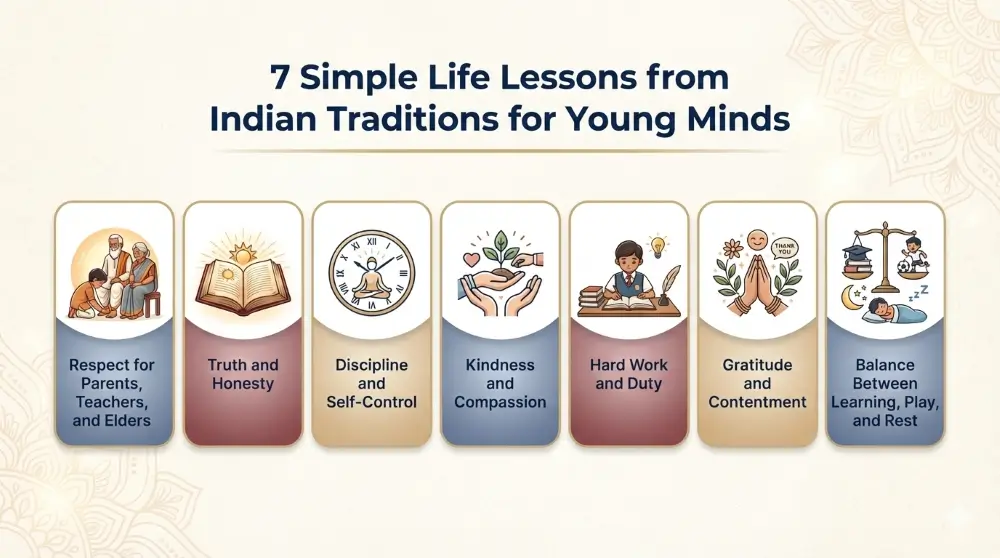
Indian traditions include various teachings for young minds, like respecting parents & teachers, the importance of truth & honesty, the value of kindness & compassion, and many more. Let’s understand each one of them in simple words:
1. Respect for Parents, Teachers, and Elders
In Indian culture, you must have heard this phrase from the Taittiriya Upanishad: “Matru Devo Bhava, Pitru Devo Bhava, Acharya Devo Bhava.” That means mother is like God, father is like God, and teacher is like God. This is not just a chant; it’s a way of living life by honoring elders.
When your child learns to respect their parents, teachers, and elders, they develop basic manners.
2. Importance of Truth and Honesty
The concept of Satya (truthfulness) is the most powerful value you can give your child. Teaching them that Satyameva Jayate, which means “truth alone triumphs,” helps them build a clean conscience. Also, it teaches them how to be honest. When your child is honest, they don’t have to carry the heavy burden of pretension, which makes them much more confident in real life.
3. Value of Discipline and Self-Control
Indian traditions have always emphasized discipline through daily routines by waking up early, practicing yoga or meditation, and maintaining a balanced lifestyle. When your child follows a routine, they learn discipline and self-control.
4. Learning Kindness and Compassion
Indian traditions teach us Vasudhaiva Kutumbakam, the idea that the whole world is one family. You can teach your child kindness and compassion by showing them how to care for plants, feed birds, or help a friend in need. This empathy is a superpower in the modern workplace, where emotional intelligence is often valued more than IQ.
5. Hard Work and Duty in Student Life
The concept of karma is simple: your actions have consequences. So, help your child focus on efforts, not just the grades, and teach them that their duty is to do karma right now. And that’s how you take the pressure of results off from their shoulders. As a student, they learn to enjoy the process of studying because they realize that sincere hard work never goes to waste.
6. Importance of Gratitude and Contentment
In a world of “I want more,” the Indian value of Santosha (contentment) teaches satisfaction in life. And, teaching your child to say a small prayer of thanks for their food, their toys, and their family. It helps them stay positive and grateful for whatever they have. In fact, grateful children are generally happier and have a positive mindset towards everything.
7. Balance Between Learning, Play, and Rest
Your child needs time to study, but they also need time to play, explore, and rest. When life becomes all about academics, your child loses creativity, health, and joy. Indian traditions like yoga and meditation teach this balance. They show your child how to work hard but also how to relax and recharge.
How HPS Teaches These Life Lessons
Read more: Importance of Co-Curricular Activities in School Education
At Haryana Public School, Narnaul, we believe education goes beyond textbooks. We understand that simple life lessons from Indian traditions help build your child’s character and prepare them for real-life challenges.
Our curriculum integrates Indian values naturally into daily learning. Through morning assemblies, cultural programs, storytelling sessions, and value education classes, your child learns these timeless lessons effectively.
We also organize community service activities where kids learn the value of giving back. Whether it’s a cleanliness drive or helping local communities, these experiences teach empathy and responsibility, and that’s how we create an environment where these values come naturally to them through practice and experience.
Why These Life Lessons Are Relevant Today
You might wonder if simple life lessons from Indian traditions for young minds still matter in today’s digital age. So, the answer is a strong yes. In fact, these values matter more now than ever before. In a world where your child faces constant pressure from academic competition and social media comparisons, traditional values bring stability and a better understanding.
Respect teaches your child to build meaningful relationships. Honesty creates trust in a world full of fake news. Discipline helps them manage time when distractions are everywhere. Kindness makes them stand out when everyone is too busy to care.
These lessons don’t hold your child back from modern success. Instead, simple life lessons from Indian traditions for young minds give your child a moral compass that guides them through complex situations. They learn to use technology wisely, compete ethically, and succeed without losing their humanity.
Moreover, colleges, universities, and many big organizations across the world today value these soft skills, teamwork, integrity, and emotional intelligence as much as academic grades. A child who grows up with strong values achieves success in every aspect of life.
Along with that, we at Haryana Public School, Narnaul, encourage kids to practice yoga and meditation, which teach self-control and inner peace. We organize annual events & cultural programs for the pre-primary to 12th standard students that help them stay connected to their roots, and effectively instill sanskaar in them, just like our motto, Sanskar se Safalta tak. Also, our teachers focus on building respect, honesty, and kindness through their own examples and through how they interact with students.
Remember, teaching simple life lessons from Indian traditions for young minds is not about forcing old practices on a new generation. It’s about taking the best of our cultural values and presenting them in a way that helps your kids become mature personalities in their lives ahead.
For more information, you can visit Haryana Public School, Narnaul, or contact us at 8199965994.
FAQs
1. Why are Indian traditions important for children?
They provide a moral compass and emotional stability, helping kids stay grounded while they explore the modern world.
2. How do life lessons help in a child’s personality development?
Values like honesty, discipline, and empathy build confidence and emotional intelligence, which are essential for leadership and happiness.
3. Can schools teach values without religious teaching?
Absolutely. Indian traditions offer universal human values like truth, non-violence, and respect that apply to everyone regardless of their religious background.
4. How can parents support value learning at home?
The best way is through examples. When kids see you practicing gratitude, being honest, and respecting elders, they naturally follow you.
5. Are these lessons useful in today’s competitive world?
Yes, while academic skills are important, values like integrity, teamwork, and emotional balance help your child succeed in the long run. Employers value these qualities, and research shows that children with strong character perform better academically and professionally.