Imagine you walk into your CBSE Class 10 board exam, not stressed, but actually confident. Every formula, every fact, it’s all right there in your mind.
That’s the power of smart revision.
But revising smart is also an art. According to the research from the National Library of Medicine, your revision is not just about cramming; it is more about giving your brain the right method to absorb and store the information; in short, the Art of Revising. The revision techniques involve various aspects, such as timetable preparation, key focus areas, and breaking down large concepts into smaller chunks. Honestly, these ideas work great for exam preparations.
To understand this better, let’s dive right into some practical strategies that actually make revision easier and less stressful.
Top 10 Effective Revision Techniques
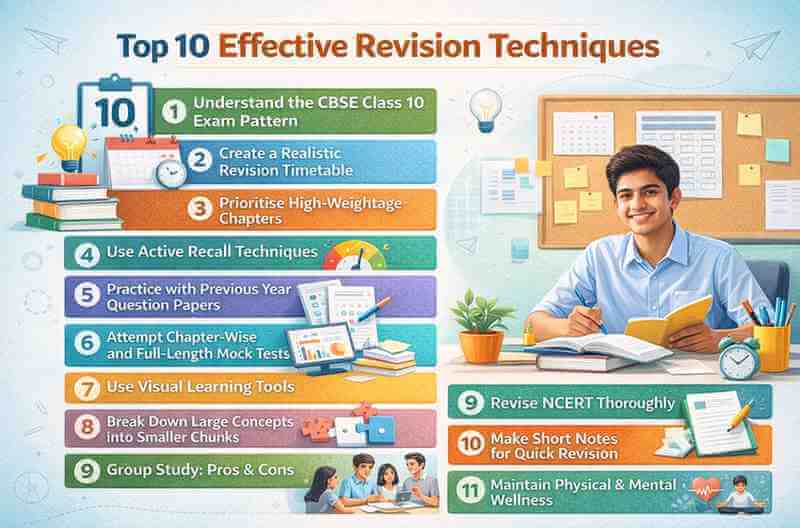
Revising for exams is not just about flipping through your notes again and again. You have to get involved, test yourself, push your brain a little, and actually see what you remember. Here are the best CBSE Class 10 revision techniques you can use:
1. Understand the CBSE Class 10 Exam Pattern
Start by getting to know the exam inside out. Look up the marking scheme, figure out which sections carry more weight (like MCQs versus case studies), and check how much time you get for each paper. Once you know the pattern, you can plan your practice and manage your time much better on exam day.
2. Create a Realistic Revision Timetable
Don’t create a schedule that you will never follow. Keep it realistic and flexible. Block out time for each subject, even down to specific chapters. Build proper breaks, and get adequate sleep. However, the best timetable is the one you actually stick to.
3. Prioritise High-Weightage Chapters
Be strategic. Use the official CBSE syllabus and sample papers to spot the chapters that matter most. Spend more of your revision time on high-weightage topics. That way, you can always cover the key areas, scoring areas that will help you score the most.
4. Use Active Recall Techniques
Here’s the game-changer: Active Recall. Don’t just read. After you study something, shut your book and try writing down everything you remember. This makes your brain work, and you will remember way more. So, flashcards and the ‘blurting’ method work great for this.
5. Practice with Previous Year Question Papers
You must solve the previous year’s question papers. Start with questions from each topic, then move on to full papers. You will understand better how the board asks things, which topics pop up the most, and the typical language used.
6. Attempt Chapter-Wise and Full-Length Mock Tests
Testing yourself is the only way to know if you have really got a concept down. Take chapter-wise tests to check your grip on each topic. When you are close to finishing your syllabus, start doing full mock exams. Time yourself just like the real thing, and always check where you went wrong.
7. Use Visual Learning Tools
Subjects like Science, Maths, and Social Science are packed with tricky topics, and visuals help to understand them better. Therefore, draw mind maps, flowcharts, diagrams, whatever helps you to simplify the concepts.
8. Break Down Large Concepts into Smaller Chunks
Staring down a massive chapter? Break it up. Take one small section at a time, make sure you are clear on it, take a quick breather, then move on. It keeps you from burning out and makes material feel manageable.
9. Revise NCERT Thoroughly
NCERT textbooks are the primary source for the CBSE exams. Every question is built from what’s in those books. Focus your main revision on understanding the NCERT, especially for Maths, Science, and Social Science.
10. Make Short Notes for Quick Revision
As you study, write down key formulas, definitions, dates, and points in short, sharp notes as part of your daily revision techniques. These micro-notes are gold in the last few days, they let you revise fast without going through whole chapters again.
11. Group Study: Pros & Cons
Studying in a group can really help and is often included among effective revision techniques, especially when you explain things to others. It actually gives you a clear picture of what you know. But only do this with people who are as focused as you are, or you will just waste time. To ensure you do not waste time, set clear goals for each session.
12. Maintain Physical & Mental Wellness
Your brain is your biggest asset, so take care of it. Get your 7 to 8 hours of sleep. Eat well, drink water, and fit in a bit of exercise or some meditation. A rested, healthy mind always works better than a tired one.
Read more: 10 Time Management Tips for Students During Exam Season – HPS
Avoid Common Mistakes During Revision
You should avoid these common mistakes while doing revision:
- Procrastination: Don’t put off difficult chapters. Pick your weak sections first, while your mind is fresh and you have the most energy.
- Passive Reading: Just highlighting or reading the same thing over and over doesn’t work. Get into active recall and test yourself instead.
- Skipping Analysis: After a mock test, don’t just check your score and move on. Dig into your mistakes, figure out where you went wrong, and go back to fix those concepts.
- Neglecting Sleep: All-nighters might seem like you are getting ahead, but in the long run, they harm your memory and your focus.
Success in CBSE Class 10 exams isn’t some impossible dream. Consistency, discipline, and making every bit of your study time count are what build real, lasting knowledge through the right revision techniques.
At HPS Narnaul, we know that a good environment matters just as much as what’s in the textbooks. We go beyond in not only guiding you with the best revision techniques but also helping you to develop skills like critical thinking, time management, and actually knowing how to take a test.
Our teachers don’t just lecture, they guide you through structured revision plans and give feedback that’s tailored to you, so you are not just aiming to pass but to truly excel. If you want a school that pushes for both strong academics and overall growth, we invite you to connect with HPS Narnaul.
FAQs:
1. When should I start revising for the CBSE Class 10 board exams?
Once you finish your syllabus, give yourself a good 2 to 3 months just for revision. That’s when you really lock things in.
2. How many hours should a Class 10 student study daily during revision?
Aiming for at least 6-8 hours of focused study each day when revision is important.
3. Which revision technique is the most effective for Class 10 students?
Active Recall basically tests yourself without peeking at your notes. It works wonders. Mix in lots of mock tests too. These two methods really boost your memory and confidence.
4. Is NCERT enough for Class 10 board exam preparation?
Absolutely. NCERT covers your concepts well. If you want more practice, especially for Maths, you can dip into reference books, but NCERT is the main thing.
5. What is the best way to revise long chapters?
Use the “Break Down and Conquer” method. Divide the long chapter into 4-5 sub-topics, master one at a time, and then attempt chapter-wise questions before moving to the next.
6. How can I avoid stress during the board exam preparation?
Stick to a routine, sleep well, and don’t skip meals. Try a bit of mindfulness or light exercise now and then. And seriously, don’t waste energy comparing yourself to others.
7. Can I revise all subjects on the same day?
It is often more effective to revise 1 or 2 core subjects (like Maths/Science) and 1 lighter subject (like English/Hindi) daily to maintain balance and prevent fatigue.
8. What should I do in the last week before the exam?
Focus solely on revising your short notes, formulas, and key diagrams. Avoid learning any new topics and solve just one final full-length mock test.
This post is very useful for both students and parents. The structured study plan and revision tips can make a huge difference in Class 10 and 12 results.We’d love to hear from you! Contact the ClassroomAI–Sifocom team for inquiries, support, or collaborations. Let’s make learning smarter together.Reach out to us at website: https://classroomai-sifocom.net/ or Email: helpdesk1@sifocom.net or call +91 87929 54724 / +91 87929 54725. We’re here to help you 24/7 with your Classroom-AI journey