
Have you ever wondered why some students solve problems in minutes while others take hours to come up with a solution?
The difference isn’t lack of intelligence; it’s actually logical thinking. A student who understands why something works will always perform better than one who simply memorizes. Logical thinking shapes how students face challenges, analyse situations, connect ideas, and make smart decisions. And the good part? It’s not something they are born with but develop over time.
If you are looking for the answer to the question of how to improve logical thinking, then you are at the right place. This blog explores practical ways to improve logical thinking among students to build sharp minds from a young age.
What Is Logical Thinking?
In simple terms, the ability to make sense of information, think critically, identify problems, and draw reasoned conclusions is called logical thinking or logical reasoning. When children think logically, they handle situations in a better way, choose wisely, and don’t react or make decisions impulsively.
Why Students Need Logical Thinking Skills
Logical thinking is not just another skill, but an important part of every student’s life. It benefits them in multiple ways, from better problem-solving, stronger decision-making, improved academic performance, to higher creativity. Such skills enhance their power and ability to think out of the box and even prepare them for real-life challenges.
Common Challenges Students Face While Doing Logical Thinking
According to the National Library of Medicine, a common misconception among parents is that they often assume that if their child is good at memorizing, then they are also good at logical thinking. But in reality, intelligence and memorization are completely different from logical skills; while many children develop logical skills, some struggle with them, which highlights the need to understand how to improve logical thinking from an early stage.
Here are some challenges that students face while doing logical thinking:
- Most students depend upon rote learning and only memorize rather than understand.
- Due to the habit of rote learning, students don’t think too much and stop asking questions like “why” and “how”. This leads to a lack of curiosity and imagination, which directly affects how to improve logical thinking.
- When students have a fear of failure or embarrassment, they don’t try to experiment or explore. This limits their exposure to problem-based tasks.
- Children with a lack of focus get distracted easily and can only stay focused for a short period of time.
Practical Ways on How to Improve Logical Thinking in Students
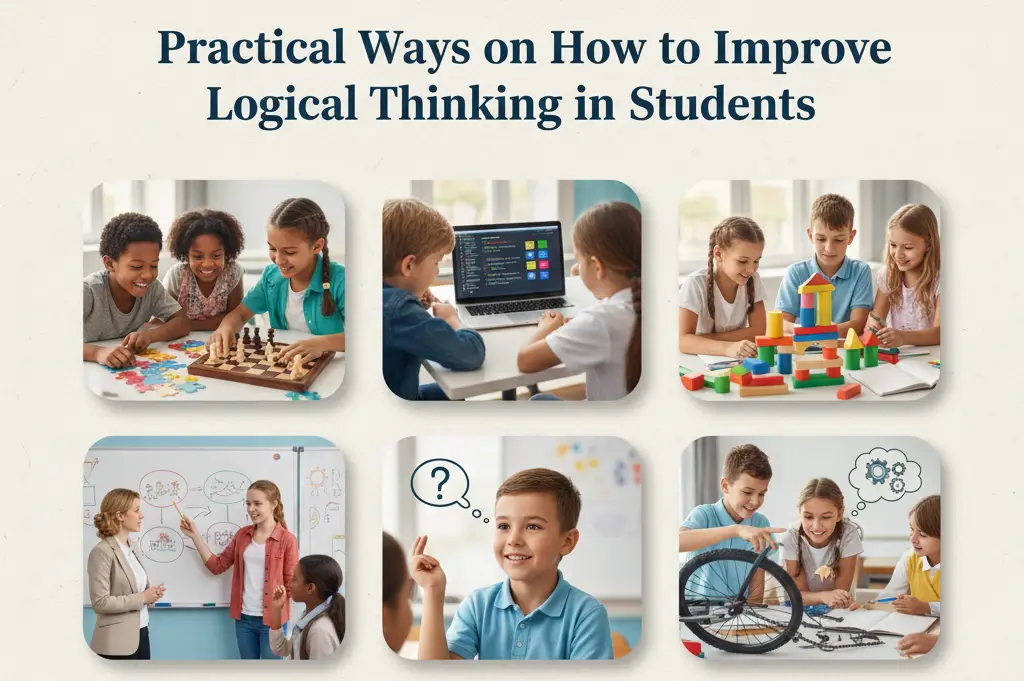
With proper practice, support, and guidance from teachers and parents, students can easily develop logical thinking.
Here are some effective ways through which you can improve this skill:
- Engaging activities
The main component of logical thinking is observation and analytical abilities. And introducing your child to engaging activities like riddles, sudoku, or pattern-recognition exercises slowly helps them gain these skills.
- Solve puzzles and brain teasers
Interesting games like solving puzzles and brain teasers train the mind to analyse information systematically and find solutions with a calm and composed mind.
- Play strategy games
Games like chess and Rubik’s Cube require strategy, planning, and foresight. Playing such games helps students sharpen their minds.
- Practice coding
Practising coding helps students learn to break problems into logical steps. This step-by-step problem-solving habit improves and builds their blocks of logic.
- Incorporate creative activities
Having creative hobbies and passions like music, dance, storytelling, painting, etc., helps students blend logic with imagination and enhance balanced thinking.
- Interactive learning
Interaction through group discussions builds curiosity and confidence among children; from there, they find the courage to ask questions, experiment, and explore more.
- Encourage questioning
Teachers should encourage students to ask questions like “why” and “how” during class. This way, they clear doubts and gain a deeper understanding of topics, which positively impacts their overall academic performance.
- Use real-world scenarios
Applying learnings from home and classrooms to real life helps students put logic into practical problems. For example, tasks like budgeting a picnic or planning a science project
- Engage in debates and discussions
Participating in debate competitions develops reasoning, initiates constructive criticism, and gives clarity of thoughts and emotions among students.
- Utilize Mind Mapping
Mind maps are another very effective way to build logical thinking, as they help students visualise relationships between ideas and form structured explanations.
Structured learning
Structured learning basically means teaching and learning in a planned, step-by-step, and organised way. Through this way, students become aware of what they are learning, why they are learning, and what the next step will be.
Let’s understand different ways of structured learning that help students gain the skill of logical thinking:
- Practice step-by-step problem-solving
When solving a problem, you should never react or make instant decisions. Instead, you should follow a simple 4-step structure, which includes understanding the problem, planning an approach, solving step by step, and then checking and explaining the answer. This builds the habit of thinking in order and avoiding random guessing.
- Encourage reading
Reading habits help students connect ideas, rather than just remembering lines. This habit makes students more focused and determined towards their work.
- Take quizzes and Olympiads
To develop the skill of high-order thinking, you should make your child take quizzes and olympiads as they help them learn different types of reasoning, like patterns, analogies, classification, verbal, and non-verbal reasoning.
Read also: Emotional Intelligence in School
Classroom Strategies Teachers Can Use
Teachers play a very important role in developing logical thinking skills in students, as several effective ways to in-built such skills start from the classroom only. This clearly shows how to improve logical thinking through daily teaching practices.
Below are some classroom strategies that teachers can use to develop logical thinking in students:
- Teachers should regularly ask open-ended questions like “why”, “how”, and “what if”. These habits of asking questions develop curiosity among children.
- Teachers should push students to get out of their comfort zone and encourage them to participate in extracurricular activities.
- Promoting collaborative learning through group discussions, debates, and interactions is yet another very effective way that teachers can help students analyse situations, argue logically, and accept different viewpoints. Hence, resulting in better logical thinking. helping them learn how to improve logical thinking in real-life situations.
Haryana Public School (HPS) understands the importance of logical thinking. Therefore, our teachers encourage students to participate in extra-curricular activities such as painting, storytelling, debates, quizzes, and more. Through such creative activities, students gain valuable skills like logical thinking.
If you are a parent looking for the best CBSE school in Narnaul that values real-life skills like logical thinking and prepares them for the future, then HPS is the right choice for your child.
For more information, visit https://www.hpsnarnaul.co.in/