Have you ever wondered what prepares students to become the tech experts, engineers, and innovators of tomorrow? The answer lies in a strong approach to learning that’s transforming classrooms across the country.
Whether you are a parent or a student, you must have observed that the world is changing around you.
However, by the passage of time, you will notice that the way people work is changing faster than ever. With innovations coming up every day, the jobs you see today might look completely different in the next ten years. This is where STEM education in India plays a major role in building your child into a future innovator by driving creativity, hands-on learning, and critical thinking.
Even to promote STEM education in India, the government of India launched Atal Tinkering Lab under the Atal Innovation Mission, encouraging hands-on learning for young minds. Now, students can experiment with robotics, 3D printing, and other technologies, which can help them develop an understanding of the chosen subject practically.
But what exactly the STEM education in India is and how is it transforming the narratives of education in the young mind?
Let’s dive deeper into how it can help your child get the passport to an exciting and successful future.
What is STEM Education in India?
STEM education in India is an integrated approach to learning that combines Science, Technology, Engineering, and Mathematics. It encourages you to think critically, solve problems, and apply your knowledge in practical ways. It is not like a traditional education that focuses mainly on rote learning. There are many schools in India adopting STEM subjects and activities so that your child gains practical knowledge. We at Haryana Public School, Narnaul fit this trend by offering not just academic facilities but also co-curricular and extra-curricular activities, sports fields and indoor games to promote the overall development of your child. We also have a science lab, ICT lab, experienced staff and smart classes, so your child can get the support they need to thrive.
Importance of STEM Education in India
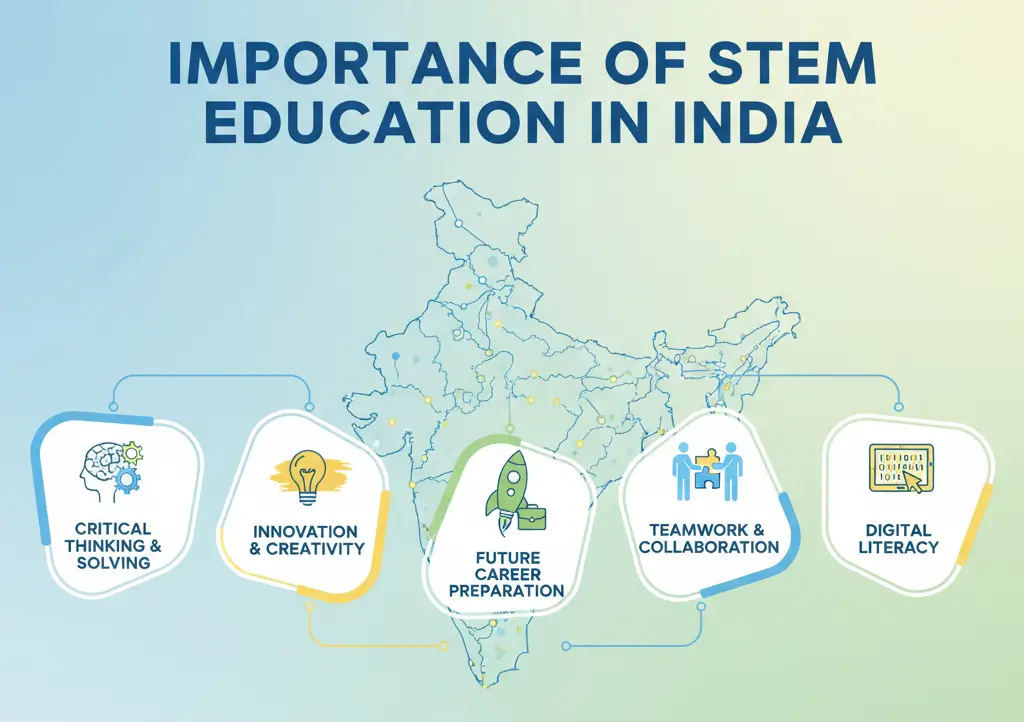
1. Develops Critical Thinking and Problem-Solving Skills
STEM education helps to train your child’s mind to think logically and critically. It helps them to learn how to analyze problems and find practical solutions, which is important both in academics or in any life journey.
2. Encourages Innovation and Creativity
By exploring new ideas and experimenting with technologies, STEM education motivates your child to create and innovate. It helps to turn their imagination into inventions that can make a real difference.
3. Future Careers Preparation
You can see the job market of India is changing fast. The fastest-growing job sectors like AI, data science, coding, and green technology all come from STEM fields. When your child starts to learn these skills now, they can actually prepare themselves for the best career opportunities of the future.
4. Promotes Teamwork and Collaboration
STEM projects mostly involve your child working with classmates. These activities help in developing strong communication skills and teamwork. However, this is the most important activity for your child’s overall development.
5. Build Digital Literacy
In today’s world, it’s essential for your child to understand technology, as it has become a basic need of this generation. STEM education helps your child build digital literacy. It is not by using technology from a smartphone, but by gaining the confidence to create and control it.
STEM Education at Haryana Public School, Narnaul
We at Haryana Public School (HPS) in Narnaul take STEM education seriously. We provide modern facilities like science and math labs, smart classrooms, and a discovery room to encourage scientific inquiry and creativity.
Our experienced teachers use modern teaching methods supported by technology. Besides academics, we appreciate participation in STEM-related extracurricular activities like robotics and science projects which makes learning for your child both fun and effective.
Our major aim is to prepare your child not only for exams but also for competitive entrance tests and future STEM career options.
School’s Commitment to Innovation and Excellence
We at HPS stand out for its commitment to innovation and excellence in education. We ensure an environment with well-ventilated classrooms, advanced labs, and facilities for sports and arts. This holistic approach helps in the development of your child’s overall personality.
We maintain a strong student-teacher ratio for personalised attention, which supports your child’s individual learning needs. Whether it is robotics, coding clubs, or subjects like renewable energy, we provide platforms for your child to apply their knowledge and even fail safely, which is an essential part of the innovation process. However, at HPS, Narnaul we are committed to innovation and excellence.
Conclusion
STEM education in India is a strong tool for building future innovators from this generation. It provides your child with essential skills and knowledge to thrive in a technology-driven world, and also makes the learning interesting and relevant.
At Haryana Public School, Narnaul, we are leading the way by combining quality education with modern technology and hands-on experiences. We embrace STEM education, which can help open up exciting career possibilities for students in the future.
So, take advantage of STEM education for your child with Haryana Public School Narnaul to explore, innovate, and shape the future.
Read more: Foundation Built in Pre-Primary CBSE School
FAQS:
1. What is STEM education?
STEM education includes Science, Technology, Engineering, and Mathematics to develop problem-solving and critical thinking skills in students.
2. Why is STEM important for students?
It prepares students for future careers, promotes innovation, and builds essential life skills like teamwork and creativity.
3. How does Haryana Public School implement STEM education?
We at HPS use modern labs, smart classrooms, and hands-on activities aligned with CBSE to foster STEM learning.
4. At what age do students start learning STEM at school?
Students usually begin STEM learning from early primary grades through practical work and concept-oriented teaching.
5. What is the aim of STEM education?
The aim is to nurture students’ knowledge by teaching practical, critical, and collaborative skills for real-world challenges.