
When you watch your child build a tower with disposable cups, pretend to run a shop, or happily splash water in a tub, it may look like a simple, fun activity. But in reality, you are witnessing Play-Based Learning in action, where real learning happens through everyday play.
Many parents believe that activities during learning can distract their child from studies. However, the truth is that Play-Based Learning helps children build important skills such as curiosity, creativity, and a stronger ability to understand concepts. It supports natural thinking, problem-solving, and emotional growth, making it one of the most powerful tools for early childhood development.
According to the National Education Policy (NEP) 2020, the foundational stage between the ages of 3 to 8 years, it is important to prioritize child’s activity-based learning to build cognitive, social, and emotional skills. This policy states that play-based learning is not an extra add-on in the classroom, but it is vital for the overall development of the child.
If you also wonder whether your child is “just playing” or actually learning, this blog will help you understand why play-based learning is essential and how it shapes every aspect of your child’s growth.
What Is Play-Based Learning?
Play-based learning means that your child experiments, discovers, and explores through hands-on activities. It grows from their curiosity and not from worksheets. Instead of sitting at a desk memorizing facts, your child learns by doing, whether pretending to cook, imitating a shopkeeper, building with blocks, or creating art.
This allows your child to develop skills while staying lively & engaged. It mixes up structured activities with free play, which gives your child the freedom to lead, and teachers guide and support the learning journey.
Why Play Matters in Early Childhood Development
While most Indian parents grow up believing that learning only happens through books, notebooks, and classroom lessons, the truth is that the strongest lessons are shaped in moments of curiosity, play, and exploring new ideas of learning while playing. Such as recognising images on a smartboard or discovering new ideas improve your child’s memory retention.
The early years shape your child’s brain in ways that last a lifetime. There are many studies and reports that say from birth to age five, your kids’ brain forms over a million new connections every single second. It sounds unreal, but it’s happening right in front of you in those tiny moments of play and curiosity while studying.
As a parent, you should understand that play-based activities are not “just play.” They are how your child makes sense of the world, experiments without fear, and builds confidence.
When your child plays, they are not memorizing random facts. They are learning how to think, how to ask why, and how to find answers on their own. During these moments, they build resilience, creativity, and emotional strength. This kind of learning doesn’t just help them do well in school; it gives them confidence and emotional balance that will stay with them for life.
Key Benefits of Play-Based Learning
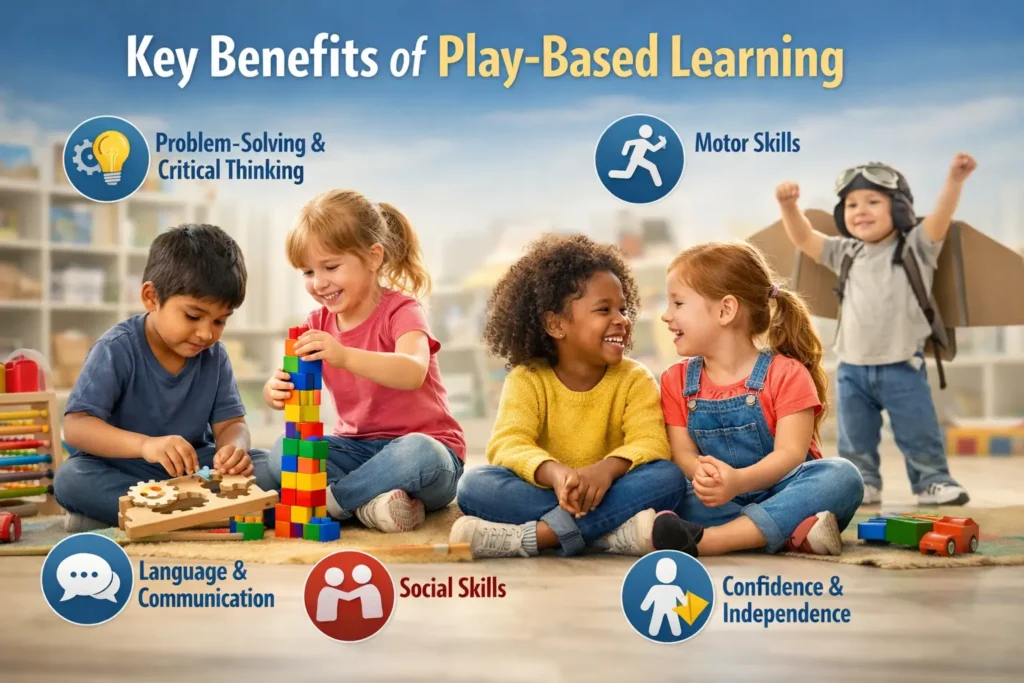
1. Improves Problem-Solving & Critical Thinking
When your child stacks blocks into a bridge or figures out how to fit puzzle pieces together, they are not just playing; they are learning to think critically. Play-based learning gets them wondering, “What if I do it this way?” or “How can I solve this?” That’s where problem-solving starts.
2. Strengthens Motor Skills
Simple things like squishing clay, threading beads, or clambering all over the playground help your child build fine and gross motor skills. They will use these every day when they write, tie their shoes, or just kick a ball around with friends.
3. Develops Communication & Language Skills
There is nothing quite like pretend play for learning. When your child runs a pretend shop or acts as the doctor with a toy patient, they try out new words, build sentences, and learn to express what’s on their mind.
4. Builds Social Skills
Play-based learning teaches your child to share, take turns, work as a team, and deal with disagreements. Spending time with other kids lets them see things from someone else’s point of view and helps them build empathy. These social skills are huge when it comes to making friends and working with others.
5. Boosts Confidence & Independence
Every time your child does a task like building a tower of cups or solving a puzzle, they feel prouder and a lot more capable in themselves. Furthermore, play-based learning activities let your child experiment, mess up, and try again. That is how they get resilient and build real confidence.
6. Supports Emotional Regulation
Play gives your child a better way to express their feelings. When they act out different scenes, they get to express emotions like fear, joy, or frustration. This sort of play helps them manage their feelings when real life gets tough.
Examples of Effective Play-Based Activities
1. Pretend-Play Setups (Kitchen, Doctor, Market)
Let your child set up a pretend kitchen or run a little market. They will copy what they see in real life, like cooking, selling, and shopping, while practising counting and talking with you or their friends. It’s fun, but they are learning a lot at the same time.
2. Storytelling and Puppet Play
Grab some puppets or just a few props and start telling stories together. This gets your child talking, imagining, and figuring out how stories fit together. They learn how to put things in order, make up their own tales, and really use their words.
3. Art & Craft Activities
Painting, drawing, and crafting allow your child to express creatively. These activities also improve hand and eye coordination and fine motor skills.
4. Outdoor Play (Sand Pits, Swings, Nature Walks)
Give them some paint, crayons, or craft supplies and let them dive in. Art time is perfect for letting your child’s creativity shine. Plus, all that drawing and cutting helps their hands and eyes work together and builds up those fine motor skills.
5. Educational Games (Patterns, Sorting, Matching)
Play simple games together where your child sorts by color, matches shapes, or looks for patterns. These activities make early math and logic skills feel more like play than work.
6. Sensory Play (Water, Clay, Rice Bins)
Let your child feel their senses. When they play with water, clay, or rice gives their brain a workout and helps them focus more. They pick up different textures and movements, which is great for learning through touch.
Read more: Importance of Co-Curricular Activities in School Education
How Teachers Support Play-Based Learning at HPS
At HPS School, we understand that play-based learning is not just about letting kids run wild at recess. There is a proper approach behind it. Our teachers set up practical, theme-based activities that bring curiosity and help every child grow.
Moreover, we mix things up with both structured and free play, so every child finds something that clicks. The classrooms have different corners like drawing, painting, and pretend-play areas, so your child can dive in and explore whatever grabs their attention.
If you want a school where teachers actually observe, guide, and support your child, and where every activity is designed with care and genuine joy, HPS Narnaul, Haryana, is the perfect place for your child.
Conclusion
Play-based learning does not mean we neglect academics. It means we build a solid base for the lifelong success of your child. Through this play, your child develops social, cognitive, and physical skills that prepare them for life and not just for academics.
At HPS School, we believe that learning should be engaging, meaningful, and fun, and that’s what we ensure in our primary classes too. By embracing play-based learning, we help children become confident, curious, and capable learners who are excited about discovering the world around them.
FAQs:
1. Is play-based learning suitable for all types of learners?
Play-based learning is flexible. You can shape it to fit different learning styles and needs. Your child gets to learn in a way that feels right for them, at their own speed.
2. Can play-based learning help children who have delayed speech or communication issues?
For sure. Play-based activities like pretend play and storytelling make it easy for kids to use language without any pressure. Over time, they pick up new words and get better at communicating.
3. Does play-based learning slow down academic progress?
Definitely not. In fact, kids who learn through play often do better in school. They build real skills, critical thinking, problem-solving, and how to work with others, all of which help them learn more effectively.
4. How can I make playtime educational at home?
It’s easy to mix learning into play. Try asking open-ended questions, bring out some educational toys, or suggest activities like sorting, building, or pretend play. These all spark curiosity and learning.
5. Can digital games be considered part of play-based learning?
Yes, as long as you use them thoughtfully. Educational apps and games can help your child learn, but they shouldn’t take the place of hands-on, physical play. Keep things balanced.
6. How does outdoor play contribute to learning?
Getting outside to play does a lot of good. It boosts physical health and lets your child explore with their senses. They learn about nature, weather, and the world around them, all while building curiosity and observation skills.