If you are a student or a parent of a student, you must have heard whispers about major changes in the CBSE’s New Assessment System 2025. These changes will mark a clear shift in how you or your kids will learn, think, memorize, and perform in school for the whole year.
However, all of these change aligns directly with the National Education Policy (NEP) 2020, but the major idea is to leave behind rote learning, just memorizing facts for exams, and focus on real, well-rounded growth.
The National Curriculum Framework also highlights that students should be able to apply knowledge in real-life situations, and not copy down textbook definitions on an answer sheet. just spit out textbook answers. They should know how to use what they’ve learned in everyday life.
Let’s deep dive into this blog to understand more about why CBSE introduced a new assessment system, key changes in the new CBSE assessment structure, what the planned changes are for the 2025-2026 academic year, and much more information.
Why CBSE’s New Assessment System 2025 Was Introduced
As we all know, the typical education system was not working for many students. You must have experienced that it is easy to memorize an entire chapter, but you cannot apply that knowledge to solve a real problem, which is one of the key reasons behind CBSE’s New Assessment System 2025.
To fix this issue, CBSE aimed to bring new changes to the assessment system through CBSE’s New Assessment System 2025. They are responding to recommendations from the NEP 2020, which says it is important to reduce exam pressure, eliminate the tuition culture, and focus on actual understanding rather than just memory work.
The board wants you to think critically, solve problems, and understand concepts deeply under CBSE’s New Assessment System 2025.
Key Changes in the New CBSE Assessment Structure
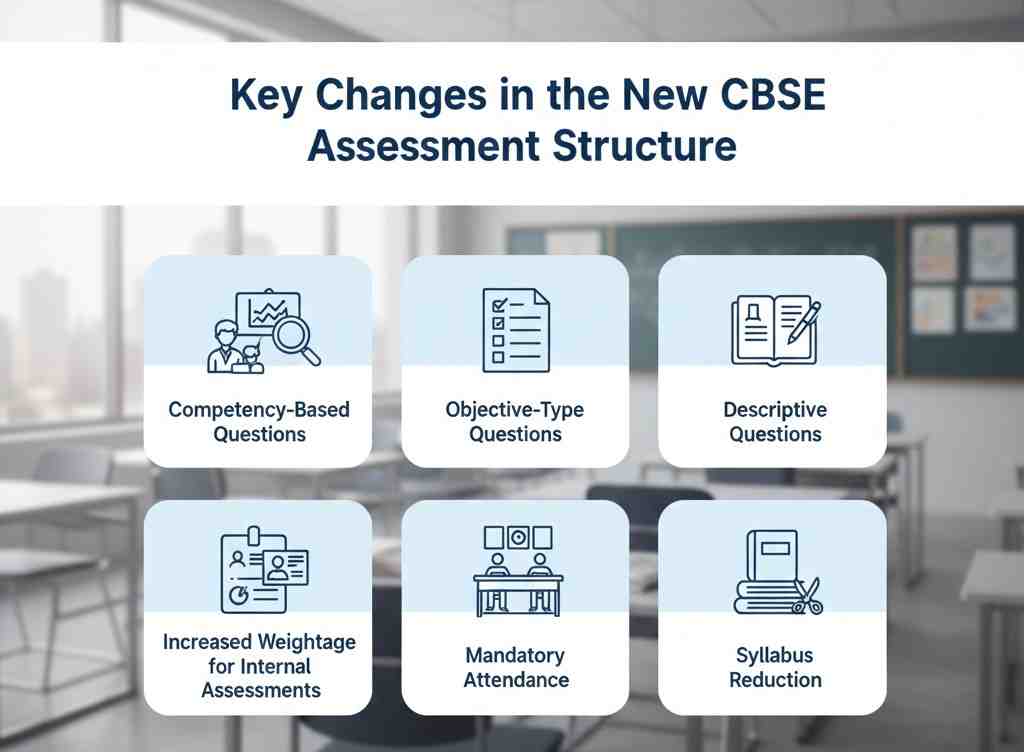
The 2025 exams are changing, and honestly, there are many things that students and parents need to know. Some of them are mentioned below:
1. Competency-Based Questions
For both Class 10 and Class 12, 50% of the question paper will now consist of competency-focused questions. These are not direct “define this” questions. Instead, they include:
- Case-Based Questions: Analyzing a given scenario.
- Source-Integrated Questions: Interpreting data or snippets.
- Real-World Application: Testing how you use concepts in practical life.
2. Objective-Type Questions
Multiple Choice Questions (MCQs) are becoming more sophisticated. They now include MCQs, which are levelling up too. It is not just about choosing the correct answer anymore. You will see assertion-reasoning and case-based MCQs. And, these demand a sharp, detailed understanding of the chapter. So, you either know it or you don’t.
3. Descriptive Questions
Descriptive questions are not going away; they are just reduced. The days of long, flowery essays are fading. Now, it is all about clear, point-wise, logical answers. You have to keep it brief.
4. Increased Weightage for Internal Assessments
Internal assessments count for more than ever. Your board exam does not decide everything now. Projects, lab work, regular tests, and even soft skills all factor into your final result. So, your effort across the year finally matters, not just how you perform on a single day.
5. Mandatory Attendance
Attendance rules are strict now. To even sit for the 2025 board exams, you need at least 75% attendance. Now you need to learn and practise together in the classroom, not just read textbooks at home.
6. Syllabus Reduction
The board is following the “Rationalized Syllabus” provided by NCERT. So, you should strictly follow the syllabus uploaded on the official CBSE Academic website rather than relying on unofficial reports of further cuts.
Planned Changes for the 2025-2026 Academic Year
Read More: Why HPS Is the Best CBSE School in Narnaul for Admission in 2025
While some changes start now, the 2025-26 session will bring even more shifts:
1. Two Board Examinations a Year
You can sit for the Board exams twice a year. No more one bad day ruins everything, and you get to keep your best score. Now you can give the exam twice a year.
2. New Grading System
There is a shift toward a more comprehensive grading system that looks at your 360-degree profile, including self-assessment and peer-assessment.
3. Flexible Passing Criteria
The system is becoming more student-centric, allowing more flexibility in choosing subjects across streams (Science, Commerce, Arts), making the rigid stream system a thing of the past.
4. Open-Book Exams for Class 9
CBSE is piloting Open-Book Examinations (OBE) for subjects like English, Mathematics, and Science for Class 9. This is not cheating; it’s actually harder. It tests how well you can find and use information to solve a problem.
What This Means for Students
Students need to stop asking, Is this important for the exam? and start asking, How does this work? If you understand the How and the Why, the new format will actually be easier for you. You will spend less time memorizing and more time exploring.
What This Means for Parents
Dear parents, it’s time to move beyond the What is your rank? mindset. Support your child in understanding concepts. If they are struggling with a case-based question, it means they need more practical exposure, not more hours of staring at a book.
The Way Forward: Improving Learning for Every Student
Regardless of the marks in the exam paper, these new changes in our education system will help many kids to unleash their potential and shape their lives. It aims to identify the unique strengths of every child, whether they are analytical, creative, or practical. It’s about building a generation that is Future Ready.
At HPS Narnaul, we believe that education is an opportunity to explore and grow, not just chase grades. That’s why our teaching style fits right in with the latest competency-based approach, so our students don’t just meet the new CBSE standards but also excel them.
If you are searching for a school that really understands today’s education needs and is ready to prepare your child for real-world challenges, HPS Narnaul is the place to start. This is where your child’s future takes shape.
FAQs:
1. What is the main purpose of CBSE’s new assessment system?
The purpose is to stop just memorizing facts and start focusing on what students can actually do with what they know and how they use it in real life.
2. What are competency-based questions?
These questions use real situations, case studies, or data. They push students to think, analyze, and solve problems, not just remember information.
3. Will exams become more difficult under the new system?
They won’t be “harder” in terms of content, but they will be “different.” Students who understand concepts will find them easier, while those who rely on memorization might find them challenging.
4. How much weightage do internal assessments carry?
Usually, internal assessments make up about a few per cent of your grade, though it changes a little depending on the subject. This part covers practicals, projects, and a few tests during the year.
5. Are NCERT textbooks still enough for exam preparation?
NCERT is still the main source, no doubt about it. But now, students need to work through extra problems and case-based questions to really understand the new approach.
6. Does the new assessment pattern benefit all types of learners?
Definitely, with more question types (like MCQs, internal assessments, and practicals), students with different strengths, whether analytical, good with words, or prefer hands-on tasks, get a chance to show what they can do.
7. How can teachers and schools help students adapt to the new pattern?
Teachers can make the shift from old-school lectures to more interactive, activity-based lessons by holding regular practice sessions with these new types of competency-based questions.