Does your child possess a unique brilliance in some subjects that standard exams simply fail to capture? Every parent wants their child to grow not only in school exams but also in logical thinking, problem-solving, and real-world understanding. Academic competitions often provide that extra platform where students can challenge themselves and explore their potential.
The HPS-TVS Brain League 2026 was one such initiative that allowed students to test their knowledge beyond routine school assessments. Designed as a national-level academic competition and scholarship program, the exam encouraged students to apply concepts, think critically, and compete in a healthy academic environment.
Organized by HPS Narnaul and TVS Gurugram, the Brain League brought together students from different classes on a common platform to test their knowledge and compete with some of the brightest young minds. If you are curious about how the competition works, this blog explains everything you need to know about the HPS-TVS Brain League 2026.
Two-Phase Scholarship Examination Program
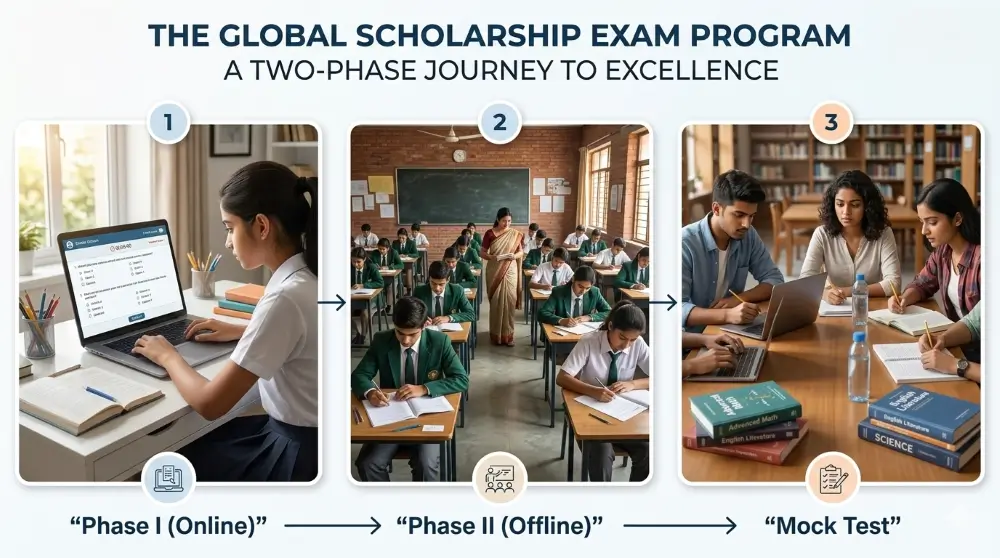
The Brain League followed a two-phase examination structure designed to identify students with strong conceptual understanding and analytical ability. By spreading the exam into two parts, both schools ensured that every student had a fair chance to prove their capabilities in both comfortable and formal settings.
1. Phase I (Online)
The first stage of the competition was conducted online, allowing students to participate conveniently.
Key details of Phase I:
- Dates: 17th and 18th January 2026.
- Mode: Online examination.
- Format: Multiple-choice questions (MCQs).
- Negative Marking: None.
Students appeared for the exam using a laptop, desktop, or mobile device with a stable internet connection. This stage tested conceptual clarity and basic subject understanding.
2. Phase II (Offline)
The second stage was conducted in a formal offline examination setting. Only students who qualified in Phase I were eligible to appear in this round.
Key details of Phase II:
- Date: Sunday, 25th January 2026.
- Mode: Offline examination.
- Venue: The exam is conducted at either the HPS Narnaul campus or the TVS Gurugram campus.
- Format: Multiple-choice questions (MCQs).
- Negative Marking: Yes, Phase II has a ¼ negative marking for each wrong answer.
3. Mock Test
To ensure that younger children felt comfortable with the online portal and the question format, a mock test was held on 16th January 2026. This practice session helped students understand the exam interface, test their internet connection, and gain confidence before appearing for the actual online test.
Eligibility Criteria
The HPS-TVS Brain League 2026 was open to students from Classes 1st to 10th. Whether a child was just starting their primary education or preparing for their secondary boards, there was a category tailored to their grade. The registration fees were kept nominal to encourage participation in the HPS-TVS Brain League 2026.
- Classes 1st to 5th: ₹150
- Classes 6th to 10th: ₹200
This made the competition accessible to a wide range of students interested in testing their academic abilities.
Exam Pattern
The exam was designed to be challenging yet age-appropriate. All questions were in MCQ format, focusing on a mix of speed and conceptual clarity. Read the table below to understand the exam pattern:
| Grade Level | Subjects Covered | Total Questions | Duration |
| Class 1 & 2 | English, EVS, Maths, GK | 30 | 60 Minutes |
| Class 3, 4 & 5 | English, EVS, Maths, GK | 40 | 60 Minutes |
| Class 6, 7 & 8 | English, Physics, Chemistry, Biology, Math, Aptitude | 45 | 60 Minutes |
| Class 9 & 10 | English, Physics, Chemistry, Biology, Math, SST | 50 | 60 Minutes |
Syllabus Overview
One of the strengths of the Brain League was that its syllabus was drawn directly from what students had already studied in school. There was nothing unfamiliar, just standard curriculum content that required focused revision for the HPS-TVS Brain League 2026.
- Class 1-5: Covered basic grammar, environmental awareness, general knowledge, and fundamental math like addition and shapes.
- Class 6-8: Dived deeper into core science concepts (like electricity or cell biology), algebraic identities, and logical reasoning (aptitude).
- Class 9-10: Followed standard CBSE content across English, physics, chemistry, biology, mathematics, and social science.
For the full class-wise, topic-by-topic syllabus, visit www.brainleague.in
General Instructions
The exam came with a clear set of instructions that students and parents were expected to follow, such as
- Students had to select their correct class (as per the 2025–26 academic session) while filling out the registration form.
- Only online registration was accepted, and no manual application forms were allowed.
- Phase I of the HPS-TVS Brain League exam was conducted in online mode.
- After successful registration, students received their user ID and password on their registered mobile number.
- Students could attempt the online Phase I exam from any location using a mobile phone, laptop, or desktop with a stable internet connection.
- Only students who qualified in Phase I were eligible to appear for Phase II (offline exam).
- For Phase II, students had to choose one examination center: either HPS Narnaul Campus or TVS Gurugram Campus, and the center could not be changed later.
- It was mandatory to carry the admit card (with a recent passport-size photograph) along with a valid school ID or Aadhaar card for the offline exam.
Tips That Helped Students Prepare
Read more: Preparing for CBSE Class 10: Effective Revision Techniques
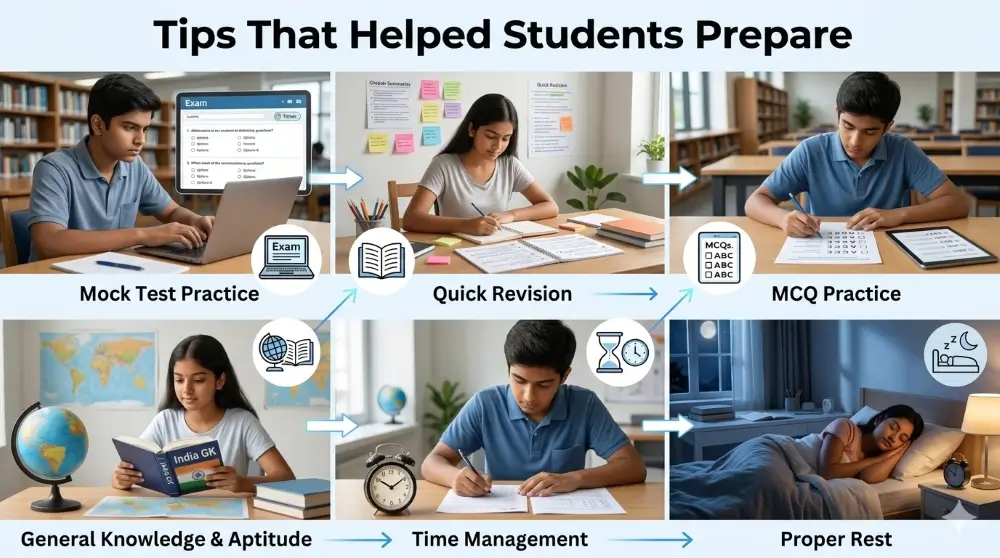
For those planning ahead for future editions, here is what worked well for students who approached this exam with a clear strategy:
1. Take the mock test seriously: The mock test was the best practice option. Students who used it to familiarize themselves with the exam pattern and revision were clearly more comfortable on exam day.
2. Revise chapter summaries, not full textbooks: The syllabus was specific. Focusing on listed topics, key formulas, and definitions was more effective for students than going through everything from scratch.
3. Practice MCQ-style questions: Multiple-choice questions require a different approach than written answers. Learning to eliminate wrong options quickly made a real difference for students.
4. Strengthen General Knowledge and Aptitude: These sections are often the deciding factor in competitive exams. Daily general knowledge and basic reasoning puzzles are added over time for students.
5. Manage time within the exam: The mock test helped students to manage time and solve 30 to 50 questions within just 60 minutes. Moving on from difficult questions rather than getting stuck was a skill that paid off.
6. Rest well the night before: No amount of last-minute revision compensates for a tired mind. Well-rested students consistently performed better.
Results
Here is a class-wise detailed table where you can read who were the 1st, 2nd, and 3rd rank holders of HPS-TVS Brain League 2026:
Class 1st
| Sr. no. | Student Name | Rank |
| 1 | Rudransh | Rank 1 |
| 2 | Avyaan garg | Rank 2 |
| 3 | Parv | Rank 2 |
| 4 | Oransh | Rank 3 |
| 5 | Kabir Aakriti Shokeen | Rank 3 |
| 6 | Khiansh Khaturia | Rank 3 |
Class 2nd
| Sr. no. | Student Name | Rank |
| 1 | Tashvik | Rank 1 |
| 2 | Savya Goyal | Rank 2 |
| 3 | Harvitha Midda | Rank 2 |
| 4 | Parth Tomar | Rank 3 |
| 5 | Purvi | Rank 3 |
| 6 | Hetansh Yadav | Rank 3 |
Class 3rd
| Sr. no. | Student Name | Rank |
| 1 | Manthika Mukhopadhyaya | Rank 1 |
| 2 | Mahi | Rank 2 |
| 3 | Sambrit Mishra | Rank 2 |
| 4 | Ekansh Narayan Sharma | Rank 3 |
| 5 | Vihaan Aggarwal | Rank 3 |
| 6 | Yashika | Rank 3 |
Class 4th
| Sr. no. | Student Name | Rank |
| 1 | Yash Yadav | Rank 1 |
| 2 | Kalpit | Rank 2 |
| 3 | Krisha | Rank 2 |
| 4 | Heshvi | Rank 3 |
| 5 | Anvi Mittal | Rank 3 |
| 6 | Kiaan Kumar | Rank 3 |
Class 5th
| Sr. no. | Student Name | Rank |
| 1 | Keshav Yadav | Rank 1 |
| 2 | Chaitanya Sharma | Rank 2 |
| 3 | Paranjay Verma | Rank 2 |
| 4 | Tejaswi | Rank 3 |
| 5 | Nityam | Rank 3 |
| 6 | Jai Sharma | Rank 3 |
Class 6th
| Sr. no. | Student Name | Rank |
| 1 | Bisman Kaur | Rank 1 |
| 2 | Yashvi | Rank 2 |
| 3 | Viraj Goyal | Rank 2 |
| 4 | Himani | Rank 3 |
| 5 | Kritin Gupta | Rank 3 |
| 6 | Vivaan | Rank 3 |
Class 7th
| Sr. no. | Student Name | Rank |
| 1 | Saaransh Yadav | Rank 1 |
| 2 | Rihaan | Rank 2 |
| 3 | Saumya Ranjan | Rank 2 |
| 4 | Jai Singhani | Rank 3 |
| 5 | Shambhawi Jha | Rank 3 |
| 6 | Prince | Rank 3 |
Class 8th
| Sr no | Student Name | Rank |
| 1 | Sejal Yadav | Rank 1 |
| 2 | Khushal | Rank 2 |
| 3 | Vishal | Rank 2 |
| 4 | Vansh Kumar Sharma | Rank 3 |
| 5 | Aradhya | Rank 3 |
| 6 | Bhawana Yadav | Rank 3 |
Class 9th
| Sr no | Student Name | Rank |
| 1 | Jivika | Rank 1 |
| 2 | Harsh Dahiya | Rank 2 |
| 3 | Shlok | Rank 2 |
| 4 | Lavi | Rank 3 |
| 5 | Shubham | Rank 3 |
| 6 | Dhruv | Rank 3 |
Class 10th
| Sr no | Student Name | Rank |
| 1 | Pankaj Gandhi | Rank 1 |
| 2 | Anshika Yadav | Rank 2 |
| 3 | Jai Shukla | Rank 2 |
| 4 | Harshit | Rank 3 |
| 5 | Siddhika | Rank 3 |
| 6 | Hitanshi Verma | Rank 3 |
Prizes
The prizes of the HPS-TVS Brain League 2026 were very thoughtful. The top performers walked away with prizes that truly reflected the effort they had put in. The 1st prize winner received a bicycle, a reward as exciting as the achievement itself. The 2nd prize winner took home an LCD writing pad, a thoughtful gift that keeps the spirit of learning going. And the 3rd prize winner was awarded a practical and meaningful school bag, a daily reminder of what hard work can earn.
These prizes were not just tokens. They were a way of telling every participant that showing up, preparing well, and giving your best always count for something.
Conclusion
Participating in the HPS-TVS Brain League 2026 was about more than just winning a scholarship; it was about the exposure and the confidence students gained by competing with other students of their age. This exam helped in identifying strengths and areas for improvement early on, setting a strong foundation for future academic success.