
Imagine that your child is not just a topper in the class but also the first one to stand up and offer their seat to an elderly person, respects and speaks calmly; a combination of intelligence and ethics. Sounds wonderful, right? That’s the kind of personality every parent wishes to see in their child.
You want your child to develop strong values and a clear sense of right and wrong to handle life’s challenges confidently. This is the reason why parents prefer schools that teach Indian values today. It’s about finding that perfect balance between modern education and traditional roots.
Now, let’s deep dive into this blog to understand the growing importance of values in education and the role of Indian values in the character and personality development of a child.
The Growing Importance of Values in Education
Education in school is no longer about memorizing facts for a 3-hour exam. It is about preparing the child for the 24 hours of daily life. When your child’s school focuses on values, it provides a safety net of principles that help your child make the right decisions even when you aren’t around. This is exactly why parents prefer schools that teach Indian values, because they believe strong cultural foundations guide children beyond academics.
In today’s time, when kids are constantly exposed to the internet and other gadgets. You must have this fear as a parent that your child will lose touch with their own culture. And the fear is genuine, because kids are becoming more tech-savvy, and they sometimes struggle with emotional resilience or social ethics. This is the reason schools are giving importance to the value of education in studies. It makes the child become a respectful and grounded individual.
What Are Indian Values in School Education?
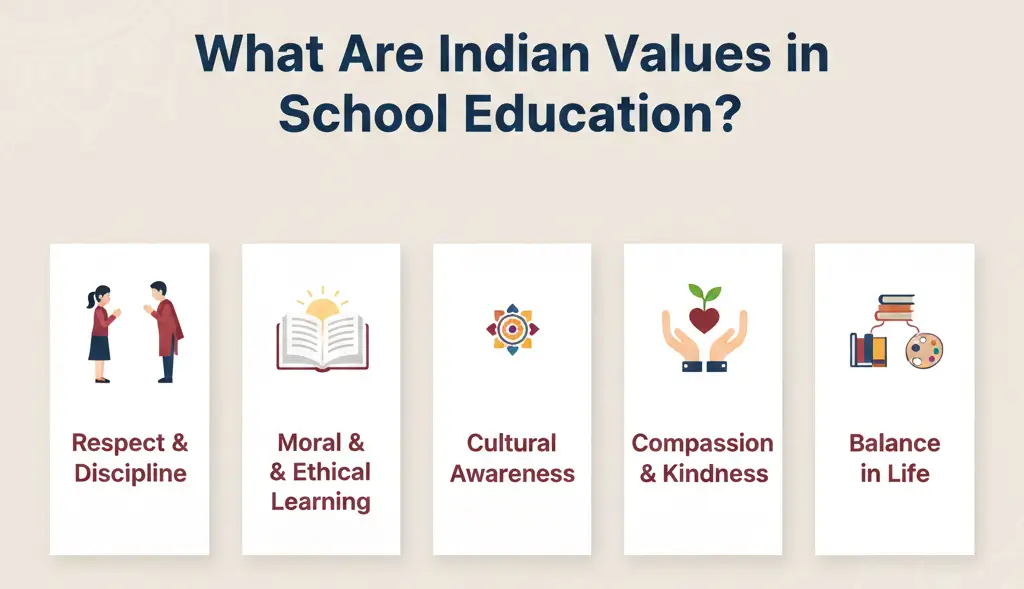
When we talk about Indian values in a school setting, we are not just talking about history lessons. We are talking about Sanskar. These include concepts from a Sanskrit phrase in the Maha Upanishad, like Vasudhaiva Kutumbakam (the world is one family), Ahimsa (non-violence), and Satya (truthfulness).
In a classroom, this translates to empathy for classmates, honesty in exams, respect for teachers, and a sense of gratitude for the resources available. It’s about teaching kids that success is meaningful only when achieved with integrity.
Why Parents Prefer Schools That Teach Indian Values for Value-Based Education
Parents today are choosing schools that focus on values because they want to see their child succeed in life, not just in exams. A child who understands the value of hard work and patience is far more likely to lead a stable, happy life than one who only focuses on competition.
Therefore, choosing value-based education brings so many advantages for a child. Let’s read one by one:
- In this competitive world, you want your child to stand out, not just with grades, but with the right character. This is where schools play a major role, where teachers ask kids to perform leadership tasks, make teams, and do debates. This helps them learn to respect the perspectives of peers.
- In a fast-paced era, where everyone is busy building their career, it’s easy to lose touch with culture and community. When schools teach Indian values, it helps your child stay connected with their heritage while embracing modern knowledge.
Teaching Respect for Parents, Teachers, and Society
A school that emphasizes Indian values teaches kids that teachers are not just knowledge providers; they are mentors, guides, and second parents. This is one of the main reasons why parents prefer schools that teach Indian values, because they want their children to grow up with deep respect for their teachers and elders. When your child touches their teacher’s feet during festivals or addresses them with “Ma’am” and “Sir,” it’s not just a formality; it’s a gesture of gratitude and humility for those who are guiding you towards life.
Moreover, this respect extends beyond the classroom. Kids learn to honor their parents, respect elders, care for their younger ones, and care for other people in society. They understand that every human deserves dignity, and every person has value.
Role of Indian Values in Character and Personality Development
Have you ever seen a child who stays calm during a difficult test or remains humble after a big win? That is the power of character. Indian values like patience (Dhairya) and self-discipline (Sanyam) are the building blocks of a strong personality.
When these values are part of the school curriculum, your child becomes more resilient. They learn to handle failure without losing hope and handle success without becoming arrogant.
A child rooted in values does not crumble under pressure. They don’t compromise their integrity for shortcuts. They stand tall, make thoughtful decisions, and treat others with kindness. This is the kind of personality that opens doors not just in careers but also in social life.
How Value-Based Education Supports Academic Growth
It might surprise you, but values and grades go hand-in-hand. A disciplined child who respects their time and their teacher’s instructions is generally more focused. When your child values “Vidya” (knowledge), they don’t just study to pass; they study to learn. This connection between character and academics is another reason why parents prefer schools that teach Indian values, because they understand that strong morals often lead to stronger performance.
Kids who instill values from teachers in school handle academic stress better. They don’t see exams as pressure. Instead, they see them as opportunities to showcase what they have learned. And that’s how they understand that their self-worth is not solely based on grades.
Indian Values and Social Responsibility
Social responsibility means knowing your actions impact others, and you have a duty to contribute good values to society. Indian values naturally encourage this kind of awareness.
Schools that focus on Indian values organize community service activities, environmental drives, and other programs that engage kids. One week, your child is planting trees; then they are cleaning public spaces or visiting an old-age home. Through these activities, kids don’t just learn about social responsibility; they also get involved.
This hands-on experience creates socially conscious individuals who care about the world beyond themselves. Also, your child grows up knowing that they are part of a larger community and their actions matter.
How HPS Teaches Indian Values in Daily School Life
At HPS (Haryana Public School), Narnaul, we don’t just teach values from books; we make them part of everyday life. This is a strong reason why parents prefer schools that teach Indian values, because they want their children to experience values in action, not just read about them. Our morning starts with traditional prayers, and you will see those same values in the way teachers and students connect throughout the day. Every little moment here helps shape your child’s character.
We integrate Indian values right into our CBSE curriculum. So, your child keeps up with today’s world but stays grounded in their roots. Whether we are celebrating festivals, participating in community services, or just sticking to good habits in class, we make sure that “Sanskar” and “Shiksha” always go together.
Conclusion
Choosing a school is one of the most crucial decisions you will ever make. While fancy buildings and high-end technology are attractive, what really sets a school apart are its values. This is exactly why parents prefer schools that teach Indian values, because they look beyond infrastructure and focus on character-building.
Moreover, you want your child to learn more than just math or science. You want them to become ready for a good job and, honestly, ready for life itself. That’s why parents prefer schools that teach Indian values, as it ensures their kids grow up to be successful professionals and, more importantly, wonderful human beings.
At HPS, the best school in Narnaul, we understand that kids need education that goes beyond textbooks, and that’s why we have this commitment to nurture students who are not only academically excellent but also ethically grounded, culturally proud, and socially responsible.
FAQs:
1. What do Indian values mean in school education?
In school, Indian values mean teaching kids respect, empathy, honesty, and a sense of duty toward their family and country. It’s about building character alongside academic knowledge.
2. Is value-based education different from religious teaching?
Yes. While religious teaching focuses on specific faiths, value-based education focuses on universal ethics like kindness, truth, and respect, which are common to all and essential for human growth.
3. How do Indian values help in a child’s personality development?
They build emotional intelligence, resilience, and humility. A child with strong values is more confident and can handle life’s ups and downs with a balanced mind.
4. Can value education improve academic performance?
Absolutely. Values like discipline, focus, and respect for learning lead to better study habits, which naturally result in better academic performance.
5. Why do parents prefer schools that focus on ethics and discipline?
Parents want their kids to be safe and well-behaved. Schools with a strong focus on ethics provide a positive environment where children learn the importance of boundaries and integrity.